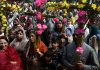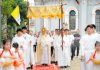

Local churches across Thailand have been marking the Holy Year 2025 through Masses, pilgrimages, and pastoral activities organized by dioceses and parishes throughout the year, culminating in diocesan-level closing ceremonies toward the end of 2025.
While the universal Jubilee will formally conclude with a unified closing in Rome, local dioceses worldwide have been holding their own concluding liturgies and reflections, symbolizing the completion of pilgrimage opportunities for the faithful at the local level.
In Catholic tradition, a Jubilee Year is a sacred time of grace, forgiveness, and spiritual renewal, inviting believers to deepen their faith and reconnect with what is often described as the “heart of the Church” in Rome.
Ordinarily celebrated every 25 years, a Jubilee encourages repentance, reconciliation, the forgiveness of sins, and renewed commitment to Christian life.
The Christian Jubilee has ancient roots. In 1300, Pope Boniface VIII proclaimed the first Holy Year, calling the faithful to pilgrimage, conversion, forgiveness, and a renewed focus on spiritual life.
Since then, each Jubilee has been designated as a special year of grace, during which the faithful may receive a plenary indulgence under the usual conditions.
Recognizing that many Catholics are unable to travel to Rome, local bishops designate important shrines and churches as official pilgrimage sites within their dioceses, allowing the faithful to participate fully in the Jubilee experience.
In the Archdiocese of Bangkok, one of the designated pilgrimage sites was the Blessed Fr. Nicholas Boonkerd Kitbamrung Shrine in Samphran, west of the capital.
Throughout the year, the shrine hosted pilgrimages, Eucharistic celebrations, and pastoral events linked to the Holy Year.
These activities culminated in a full-day closing program on Dec. 13, 2025, concluding with an evening Mass.
Among the highlights of the day was a panel discussion reflecting on the meaning and fruits of Jubilee grace, featuring voices from clergy, religious, lay professionals, and representatives of other faith traditions.
Sister Marie Agnes Buasap, SPC, emphasized the importance of nurturing hope, especially among young people. She stressed that hope often begins with small, attentive gestures.
“Simple acts, making eye contact, listening with empathy, and taking young people’s struggles seriously can restore their sense of dignity and hope,” she said.
She shared a personal encounter with a school parent who had attempted suicide.
“It began with a simple visit,” she recalled. “Before the parent even spoke about their pain, God allowed me to understand their struggle. The person later realized how deeply God loved them. I was only His instrument.”
Panuwat Lertprasertpand, a Chinese Buddhist monk, reflected on the importance of cooperation among religions, particularly in responding together to human suffering. He highlighted that compassion and service provide common ground for people of all faiths.
Popular singer Praparp Tunjarune, widely known as Fen, spoke of hope rooted in his faith in God, sharing that her music has become a form of prayer and praise.
“Singing is my way of giving thanks and offering hope to others,” she said.
Dr. Padthera Anna Narkurairattana, a university professor, expressed her hope for peace grounded in justice, particularly in Thailand’s Deep South, where historical grievances and perceptions of state oppression continue to fuel sporadic violence.
She underscored that reconciliation cannot be separated from justice and mutual understanding.
Responding to the guiding question, “What does hope look like, and how can its power change the world?”, Father John Baptist Somkiat Trinikorn, a parish priest, offered a reflection anchored in the Jubilee theme, “Pilgrims of Hope.”
He explained that hope is not merely a feeling but a journey, “a movement of the heart that refuses to remain still, even when the world is heavy with suffering.”
Hope, he said, is not an abstract vision of the future but is embodied in people who choose to act with love in the present.
“Hope has the face of ordinary people who refuse to let evil triumph over good,” he said. “It belongs to those who dare to forgive, even when there are many reasons to hate.”
Father Somkiat stressed that hope is not fantasy but a quiet, resilient courage, a power that stands firm, does not give up, and does not close its heart.
“War and injustice begin with hopelessness,” he noted, “but peace begins when one person dares to say, ‘We can do better.’”
He added that people shaped by hope find the courage to stand with the voiceless, reject violence, change their own attitudes, and build friendships across religions, cultures, and ideologies.
“This kind of courage,” he said, “moves society forward and is a power no weapon can overcome.”
Summarizing the day’s reflections, participants echoed the conviction that hope is faith translated into action, a force that awakens humanity to rise above fear and hatred.
As the Holy Doors of the Jubilee Year gradually close, speakers emphasized that the spiritual legacy of hope and forgiveness endures.
The Holy Year 2025, they said, calls believers not only to pilgrimage to sacred places but also to a “pilgrimage of the heart,” a return to the hope that sustains humanity and a commitment to carry that hope to places where it has been extinguished.
For whenever hope is restored, participants affirmed, humanity can always begin again, looking ahead with confidence to future milestones in the life of the Church, including the Jubilee of 2033.