The head of the Indonesian Bishops’ Conference said the Catholic Church’s response to devastating floods in Sumatra reflects its call to become a “field hospital,” as Church-run health posts and community kitchens continue serving affected communities.
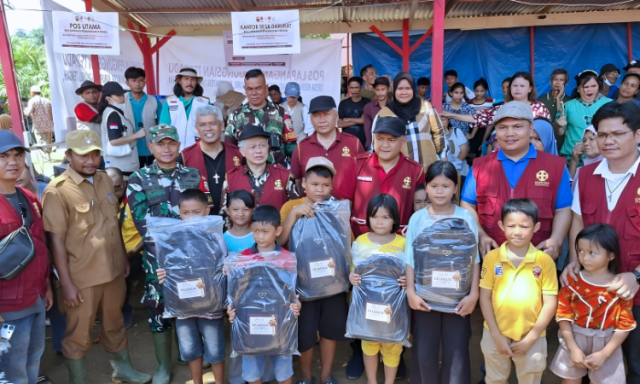
Bishop Antonius Subianto Bunjamin, OSC, made the statement during a pastoral visit to Sibolga, where he inspected emergency services operated by the Caritas Indonesia network for flood survivors.
“Recently, the Indonesian Catholic Church held its General Assembly, which encouraged the Church, especially in disaster situations, to become a field hospital, a concrete place of care,” Bunjamin said. “This is a field hospital, and there is even a community kitchen. Within this togetherness, solidarity is formed.”
The visit followed the 2025 General Assembly of the Indonesian Catholic Church, which urged dioceses nationwide to translate pastoral vision into concrete service, particularly in situations of crisis and displacement.
Bunjamin was accompanied by Bishop Pius Riana Prapdi, vice chair of the board of the KARINA Foundation of the Indonesian Bishops’ Conference, and Fr. Fredy Rante Taruk, Pr., executive director of Caritas Indonesia.
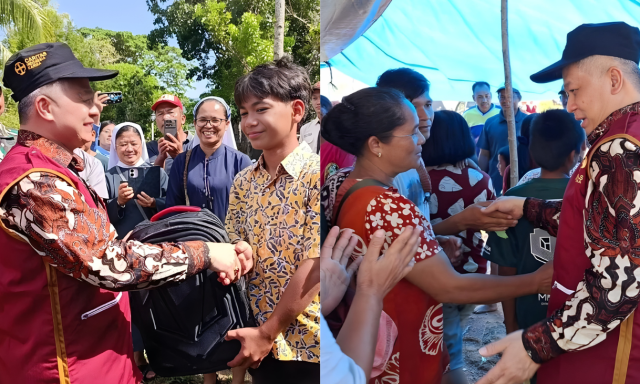
During the visit, Bunjamin conveyed expressions of solidarity from Church leaders across the country, as well as from Pope Leo XIV, to communities affected by the flooding.
“The bishops from across Indonesia, the Cardinal, and even Pope Leo XIV have expressed their compassion and closeness to our brothers and sisters affected by the disaster,” he said.
Since flooding struck several parts of Sumatra, Caritas Indonesia and its diocesan networks have coordinated emergency assistance across affected areas, involving all 38 dioceses nationwide.
The response includes health services, food distribution, hygiene kits, shelter support, psychosocial care, and the operation of community kitchens.
In the Diocese of Sibolga, Caritas Indonesia has continued providing health services with volunteer medical personnel, supported by Catholic hospitals in Sibolga and Medan and health workers from Atma Jaya Catholic University of Indonesia in Jakarta.
Services have reached dozens of flood-affected villages and evacuation sites.
The Caritas network has also expanded operations at an integrated service post in Kebon Pisang village by adding tents and installing clean water facilities.
An emergency school has been established at the site to serve elementary and junior high school students displaced by the disaster.
Church leaders have also begun discussing longer-term recovery efforts. During a meeting on Dec. 23, Bunjamin proposed a housing assistance initiative for families whose homes were damaged or destroyed by the floods.
“With a spirit of cooperation, Caritas Indonesia’s humanitarian service is carried out to provide dignified assistance and to become a concrete sign of the Church’s love for neighbors who are striving to recover from disaster,” he said.
Caritas Indonesia has activated an Emergency Appeal within the Caritas Internationalis confederation and conducted a joint needs assessment with humanitarian organizations under the Humanitarian Forum Indonesia to strengthen and coordinate the ongoing response.