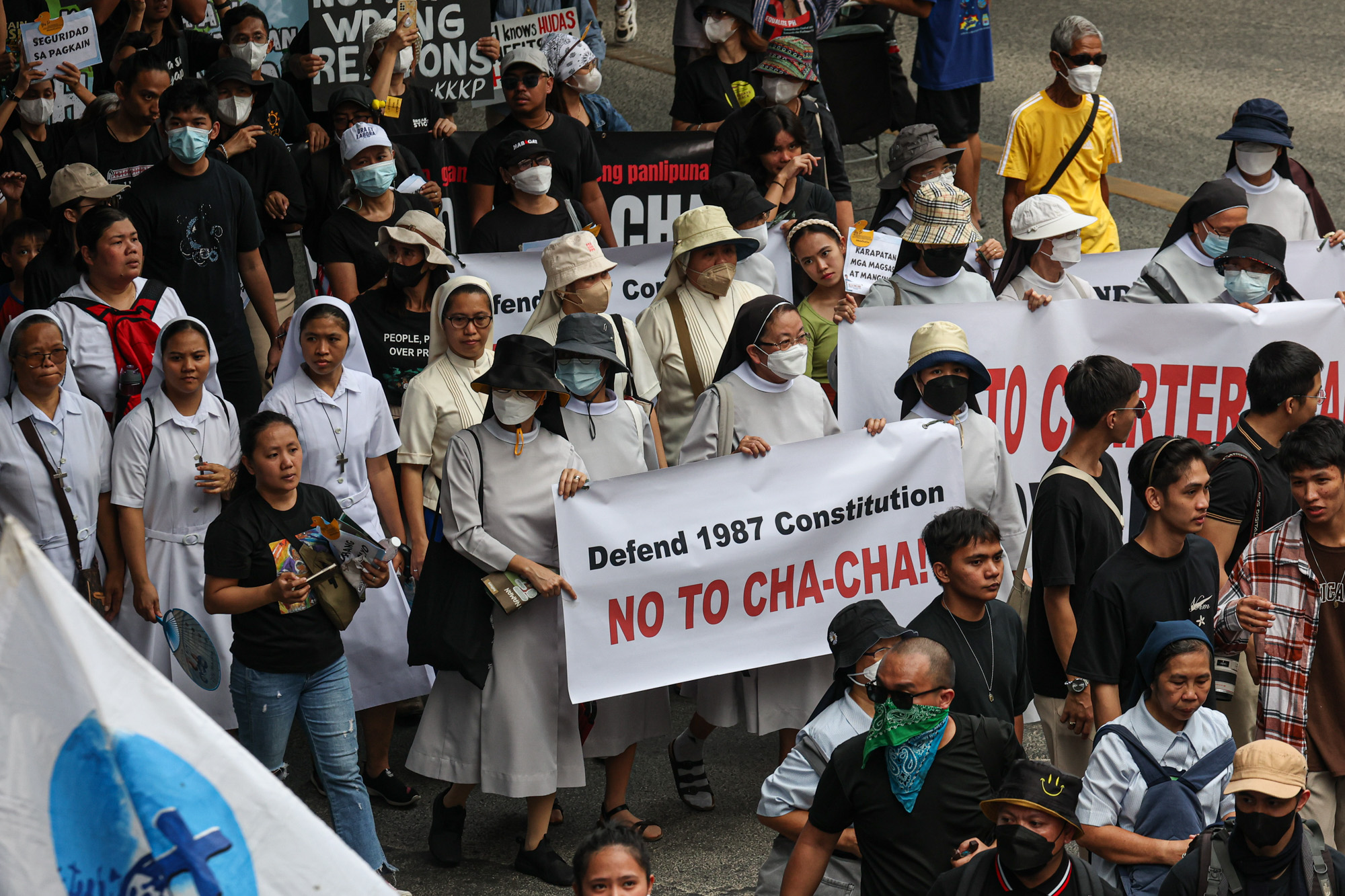
Catholic educators and Church leaders in the Philippines have urged schools to declare Feb. 25 an academic holiday for reflection and civic formation.
The leaders warned that democracy remains fragile four decades after the country’s peaceful uprising against dictatorship.
In a joint statement marking the 40th anniversary of the 1986 EDSA People Power Revolution, the Catholic Educational Association of the Philippines and the Catholic Bishops’ Conference of the Philippines’ Episcopal Commission on Catholic Education said the commemoration must confront present-day threats to democratic freedoms, not merely recall the past.
“Democracy is never self-sustaining,” the statement said, stressing that it “demands vigilance, active participation, and fidelity to truth.”
The EDSA People Power Revolution, named after Epifanio de los Santos Avenue in Manila, led to the downfall of the Marcos dictatorship through mass nonviolent protests supported by Church leaders, civil society, and segments of the military.
Recalling the events of 1986, the statement described EDSA as a moment when “millions gathered in faith, prayer, and determination to reclaim our freedom,” highlighting the role of Radio Veritas, the Catholic hierarchy, and reformist soldiers who chose loyalty to the Constitution over allegiance to an authoritarian regime.
EDSA was described as a “Rosary miracle,” and “a triumph of peaceful resistance over dictatorship,” when ordinary citizens, families, religious leaders, and young people “stood between tanks and violence, armed with a collective will.”
Forty years later, the Church-backed educators said the moral vision of EDSA remains urgent amid continuing governance challenges in the country. “Governance must be anchored in accountability, respect for human rights, transparency, and service to the common good,” the statement said.
The statement warned that forgetting past abuses carries serious consequences. “To forget the lessons of Martial Law, tolerate corruption, or allow historical distortion and disinformation to prevail jeopardize the very freedoms that were peacefully won,” it said.
As part of the anniversary observance, CEAP and the CBCP commission called on Catholic schools and educational institutions nationwide “to declare February 25 as an academic holiday for reflection, commemoration, and civic formation.”
Schools were encouraged to organize Masses, youth forums, and other educational activities aimed at strengthening ethical discernment, critical thinking, and civic responsibility. Students and young people, described as “heirs of democratic space,” were urged to cultivate the resolve “to challenge injustice, misinformation, and authoritarian tendencies.”
The statement also addressed other sectors of society, calling on civil society groups, human rights advocates, and media organizations to continue safeguarding democratic freedoms. Media practitioners, it said, are urged “to defend press freedom and truthful reporting as pillars against abuse of power.”
The military and police were reminded of their constitutional duty “to protect the people and uphold the law,” while business leaders were urged to promote “transparency, ethical practices, and inclusive growth.”
Lawmakers were likewise called to act, with the statement urging Congress and the Senate “to act decisively against political dynasties, dismantle massive corruption in government, and commit to people empowerment through sustainable investment in education.”
The educators emphasized that EDSA should not be treated as a closed chapter in Philippine history. “EDSA is not only a commemoration, it is an unfinished movement that demands vigilance, active participation, and collective resolve from all sectors,” the statement said.
“To honor it authentically,” it added, is “to combat revisionism, defend democratic principles, and build a nation where justice, dignity, and peace are lived realities.”