
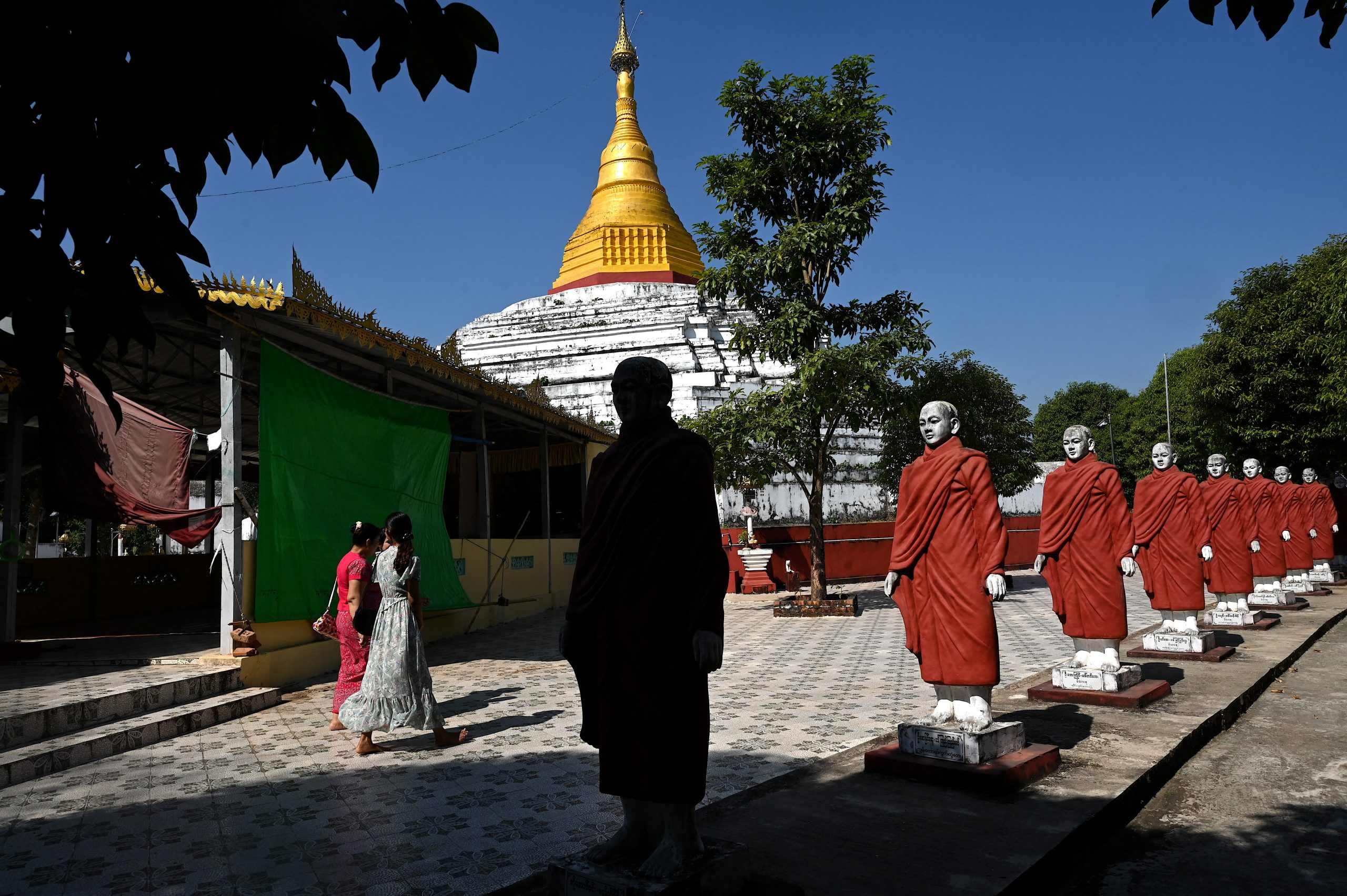
Myanmar’s military regime has increasingly used Buddhist nationalist narratives to justify crackdowns on women’s and LGBTQ rights advocates since seizing power in 2021, according to a new study that links religious fundamentalism to the country’s deepening human rights crisis.
The study, Religious Fundamentalism in Myanmar: Post-Coup Repression of Gender Rights, was released by Bangkok-based Asia Centre as part of a regional research project examining the impact of religious fundamentalism on gender rights and civic space across South and Southeast Asia.
Researchers argue that Buddhist fundamentalism has re-emerged as a powerful ideological force under military rule, helping legitimize discrimination, surveillance, and violence against women, gender, and sexual minority rights defenders.
“Within this landscape, Buddhist fundamentalism has re-emerged as a central ideological force,” the report said. “Rooted in decades of Burmanisation and Buddhisation policies, it has increasingly been mobilised post-coup to amplify state violence, legitimise discrimination and institutionalise a centralised and patriarchal Buddhist-Bamar national identity as a mechanism of political control.”
According to the report, advocates for women, gender, and sexual minority rights are increasingly portrayed as threats to religion, culture, and social order.
“In this context, WGSM rights advocacy is increasingly portrayed as a threat to ‘traditional’ Buddhist morality, national culture and social stability,” it said.
The findings come as Myanmar remains under military rule more than five years after the Feb. 1, 2021 coup, which ousted the elected government of Aung San Suu Kyi and triggered a nationwide resistance movement. Since then, international rights groups and United Nations mechanisms have documented widespread abuses, including arbitrary arrests, torture, restrictions on free expression, and attacks on civil society actors.
The report argues that military authorities and Buddhist nationalist actors have become increasingly intertwined in efforts to suppress dissent and maintain a centralized Buddhist-Bamar national identity.
Researchers identified three main forms of repression directed at women’s and LGBTQ rights advocates: the weaponization of laws, online harassment, and physical violence.
“Legally, the junta weaponises both existing and newly introduced laws to criminalise advocacy, expand surveillance and suppress dissent,” the report said. “Many of these laws are reinforced through moral narratives rooted in fundamentalist interpretations of Buddhism that frame gender and sexual diversity as threats to religion and national identity.”
Among the measures cited are the Counter-Terrorism Law, the Organisations Registration Law, provisions of the Penal Code, and amendments to the Ward and Village Tract Administration Law.
The study highlighted the case of Justin Min Hein, president of the LGBTQI+ Union in Mandalay, who was sentenced to 10 years in prison under the Counter-Terrorism Law in 2023. Researchers said the conviction was widely believed to be retaliation for his efforts to challenge the mistreatment of LGBTQI+ detainees.
The report also documented the use of Section 377 of Myanmar’s Penal Code, a colonial-era provision criminalizing same-sex relations. While prosecutions under the law remain relatively uncommon, activists interviewed for the study said the threat of its enforcement continues to be used during arrests, interrogations, and surveillance operations.
Digital platforms have become another major arena of repression, according to the report.
“Pro-military and Buddhist fundamentalist actors use social media and messaging platforms to spread hate speech, incite violence and conduct doxxing campaigns against WGSM activists; while the military structure has imposed Artificial Intelligence-enabled surveillance mechanisms,” it said.
Researchers traced the roots of contemporary Buddhist nationalism to decades of military-backed efforts to promote Burmanisation and Buddhisation, policies that sought to establish a Buddhist-Bamar national identity while marginalizing ethnic and religious minorities.
The report notes that influential nationalist movements and monks expanded their public influence during Myanmar’s political opening in the 2010s, helping shape debates on religion, citizenship, and national identity. Although some of those networks lost prominence under the National League for Democracy government, the military takeover enabled their resurgence.
“The 2021 coup marked another turning point, enabling the resurgence of Buddhist fundamentalist networks that had previously receded from public view,” the report said.
Researchers stressed that the report focuses on military-aligned Buddhist nationalist actors rather than the broader Buddhist community. The study notes that while some monks openly supported the junta, others joined pro-democracy efforts and faced arrest, violence, or persecution for doing so.
The report concludes that civic repression, religious nationalism, and gender-based discrimination should not be understood as separate developments in post-coup Myanmar, but as interconnected systems that reinforce authoritarian rule and restrict democratic participation.
“Understanding this nexus between Buddhist fundamentalism, civic repression and gendered violence is essential to grasp the complex realities shaping Myanmar’s post-coup landscape,” the report said.
The study called for stronger protection mechanisms for women’s and LGBTQ rights defenders, greater support for civil society organizations, and sustained international attention to the intersection of religious fundamentalism and human rights abuses in Myanmar.
“Only by building such capacity can local actors anticipate and counter religiously motivated backlash, sustain inclusive advocacy under repression and lay the groundwork for a democratic and pluralistic future in Myanmar,” it said.