

A Thai Buddhist scholar urged the public not to judge all Italians by the actions of a group of teenagers involved in a viral altercation aboard Bangkok’s BTS Skytrain, calling instead for compassion, cultural understanding, and character formation.
Dr. Boonchuay Doojai, a former Buddhist monk and academic scholar, offered a different perspective in a social media post after the Italian Embassy in Bangkok issued an official statement condemning the teenagers’ behavior and extending a sincere apology to the Thai public.
The incident last week, which quickly went viral, sparked widespread discussion about public conduct, respect for local culture, and the growing influence of online vigilantism.
While many social media users condemned the students’ behavior, Dr. Boonchuay instead reflected on the values of unity and love that he has experienced through decades of friendship with Italians.
Drawing from more than two decades of personal experience, he explained that his understanding of Italian culture was shaped by his participation in the Buddhist-Christian Symposium organized by the Focolare Movement.
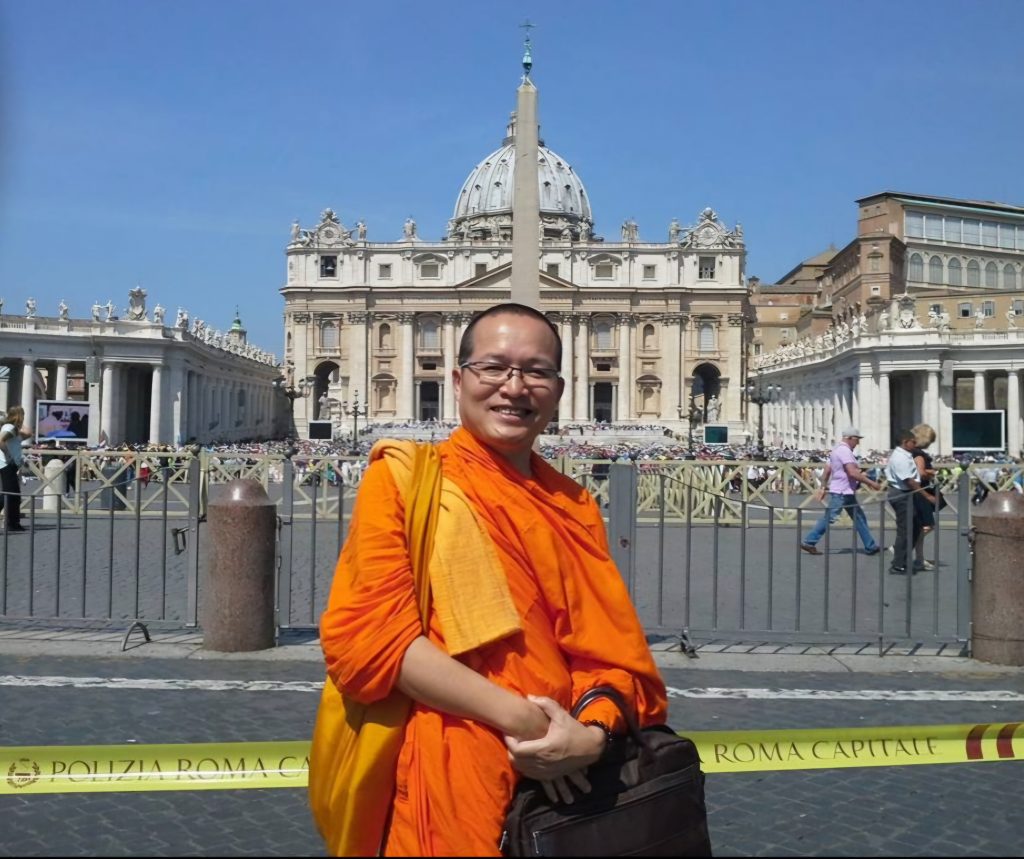
“I had the opportunity to know Italians deeply when I accompanied my teacher, the late Luang Pu Thong Sirimangkalo of Wat Phra That Si Chom Thong in Chiang Mai, to the first Buddhist-Christian Symposium in Rome in 2004,” he wrote.
The dialogue continued through numerous subsequent meetings, creating lasting friendships even after the death of his revered teacher.
“The relationship and mutual learning about living in unity, founded on the Gospel’s message of love, has remained strong until today,” he said.
Founded in Italy by Chiara Lubich and her companions in 1943 during World War II, the Focolare Movement is an international Catholic movement dedicated to promoting unity, fraternity, and dialogue among people of different cultures, religions, and backgrounds.
Officially recognized by the Holy See in 1962, the movement now serves communities in more than 180 countries and works closely not only with Christians but also with followers of other religions and people of no religious affiliation.
According to Dr. Boonchuay, one of the movement’s most distinctive educational tools is the “Cube of Love,” a simple but profound method of helping children, young people, families, and communities put love into daily practice.
Each morning, participants roll a six-sided cube, with each side displaying a short message centered on love.
The message that appears becomes the guiding principle for that day.
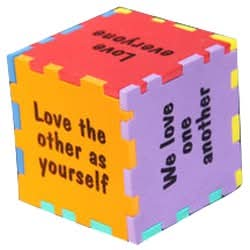
The six messages are:
Love everyone.
Love one another.
Love first.
Put yourself in others’ shoes.
Love Jesus in others.
Love your enemies.
Although the messages are brief, Dr. Boonchuay noted that each carries practical implications for everyday life.
“Love everyone” encourages people to welcome others without discrimination based on race, religion, or social status through simple acts of kindness, such as greeting strangers warmly.
“Love first” calls on people to take the initiative in reconciliation, forgiveness, and acts of service without waiting for others to make the first move.
“Put yourself in others’ shoes” teaches empathy by encouraging people to treat others with the same dignity and respect they desire for themselves.
“Love Jesus in others” invites Christians to recognize Christ in every person, especially those who are suffering or in need, inspiring concrete acts of generosity and encouragement.
“Love one another” promotes mutual cooperation and shared responsibility within families, schools, and communities.
Finally, “Love your enemies” challenges people to overcome resentment through forgiveness and to refuse to respond to wrongdoing with revenge or hatred.
Reflecting on the recent BTS incident, Dr. Boonchuay expressed regret that the Italian teenagers involved had apparently never encountered this formation in unity and love.
“It is unfortunate that the group of Italian students involved in the BTS incident did not have the opportunity to experience the Focolare Movement’s formation in living unity through love,” he wrote.
“If they had learned to practise this culture of love, behaviour that could be perceived as bullying, disrespect for another culture, or showing contempt for others might never have happened,” he added.
His comments shifted the conversation from assigning blame to exploring the deeper importance of character formation, intercultural understanding, and education rooted in compassion.
Rather than allowing one regrettable incident to define perceptions of an entire people, Dr. Boonchuay’s reflection serves as a reminder that authentic cultural exchange begins with mutual respect and a willingness to see the humanity in one another.
His message echoes the Focolare Movement’s enduring conviction that peace among people is built not merely through dialogue but through countless daily acts of love, understanding, and fraternity—values that remain as relevant as ever in an increasingly interconnected world.