

For the Deaf community, getting to know Jesus and understanding the Catholic faith is not always easy. They may attend Mass or other Church activities, but they do not necessarily understand everything communicated verbally.
That is why sign language has become an important bridge for proclaiming the Gospel.
This is what Matheas Teddy, a parishioner of the Church of the Immaculate Heart of Mary in Tangerang, and Yohanes Berchman Hendra Purnama, a parishioner of St. Augustine Church in Karawaci, Tangerang Regency, Banten, have come to understand.
Both are now actively involved in serving and helping other Deaf people come to know Jesus and understand the Catholic faith.
In their ministry, they receive assistance from Fransiskus “Frans” Dwi Susanto, a professional sign-language interpreter and parishioner of St. Leo the Great Church in Jatiwaringin, Bekasi Regency.
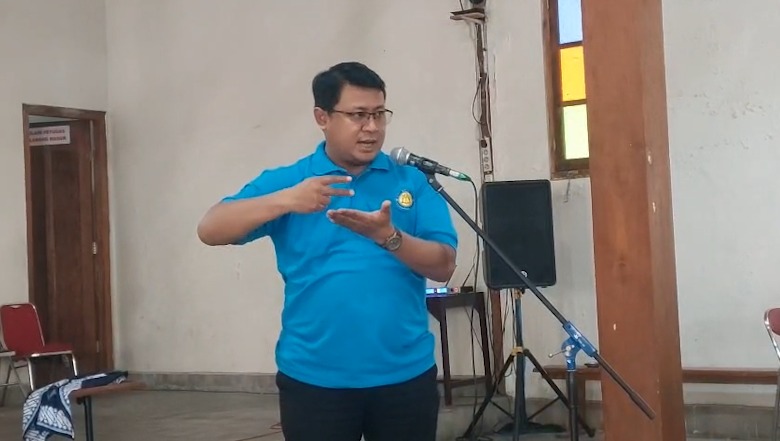
Frans said that serving as a sign-language interpreter in the Church requires more than simply translating spoken language. It also requires an understanding of Deaf culture and the character of each individual.
“Of course, this includes being able to adapt to each person’s character. We often need to be patient and learn to understand when our ministry is sometimes misunderstood,” he said.
The ministry also requires personal sacrifices, particularly time. “The time I can spend with my family and those closest to me has become limited,” he said. This is because there is still a significant need for pastoral services for people with disabilities and for sign-language classes in various places.
Frans also appreciates the involvement of Mrs. Marceline, a dentist, and Mrs. Lily Bekti, who have volunteered to serve as sign-language interpreters.
Teddy and Hendra shared their testimonies, with Frans interpreting, before around 100 catechists from three parishes in Gunungkidul Regency, Special Region of Yogyakarta, on Saturday, August 22.
Teddy’s experience
Teddy said his journey of faith began with a family experience. When his father became ill and had difficulty sleeping, a family member who was already Catholic prayed over some water and gave it to his father.
Afterward, his father gradually became calmer and was able to rest. The experience left a deep impression on Teddy, who was not yet Catholic at the time.
He later became increasingly interested in learning about the Catholic faith and realized that many Deaf people still did not know Jesus.
“Many of our deaf friends do not understand who Jesus is,” he said.
This realization encouraged Teddy to help his friends. For him, the problem is not that Deaf people lack the desire to know God, but that they have limited access to faith formation.
That is why he wants more Deaf people to have the opportunity to know Jesus through a language they can understand.
Hendra’s inner journey
Hendra also admitted that at first he did not have a deep understanding of Christianity or the Gospel. Through his involvement in a community and encounters with people who accompanied him, he gradually came to know and understand the Catholic faith.
Various experiences within the community taught him the importance of humility.
He realized that ministry is not about who is right or who is most capable, but about being willing to help others grow.
This experience eventually encouraged him to serve the Deaf community.
Ongoing catechesis
According to Teddy and Hendra, many Deaf people are mature in age and life experience, but their understanding of the Catholic faith does not always develop at the same pace.
For this reason, catechesis for the Deaf community requires an ongoing process, patience, and methods suited to their needs.
Since around 2022, Teddy, Hendra, and Frans, along with several friends, have been visiting different communities and parishes to help teach sign language related to the Catholic faith.
The more people who understand sign language, the greater the access Deaf Catholics have to the life of the Church.
Walking together
Yet both men recognize that the Deaf community cannot walk alone. They said deaf people and hearing people need to work together.
Deaf people understand the needs of their community through their own experience, while hearing Catholics can become partners and bridges in communication.
Therefore, ministry to the Deaf community is not solely the responsibility of Deaf people. It is a responsibility shared by the whole Church.
Through sign language, the Church can proclaim the Gospel in a more inclusive way and ensure that Deaf Catholics have the same opportunity to know Jesus, grow in faith, and participate fully in the life of the Church.
For Teddy, Hendra, and Frans, being Deaf is not an obstacle to becoming proclaimers of the Gospel. Their experience as Deaf people has instead become a strength that enables them to bring their friends closer to Jesus.









