A senior Catholic Church official in the Philippines has warned against treating public office as a family inheritance as Church groups stepped up calls for legislation to curb political dynasties.
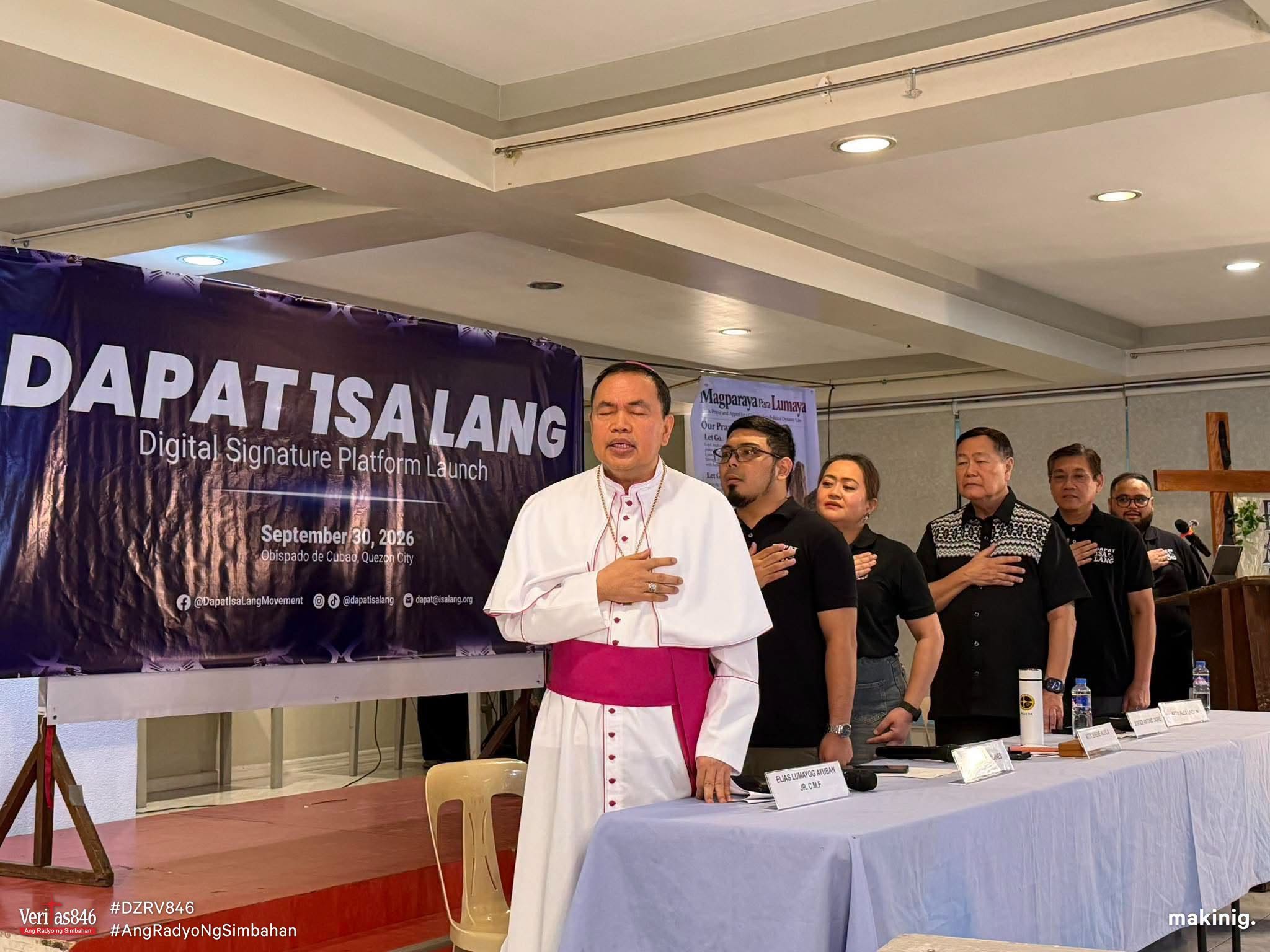
Bishop Elias Ayuban Jr. of Cubao joined priests and civic groups on Sept. 30 at the launch of the Dapat Isa Lang movement’s digital signature platform at the Obispado de Cubao in Quezon City.
“Public office must never become a family inheritance. It is a public trust entrusted to the people,” Ayuban said.
Ayuban, who is also apostolic administrator of the Diocese of Parañaque, said the campaign should not be viewed as an attack on any politician, family or political party, but as a question of concentrated political power.
He said the Church’s role was not to tell voters whom to elect but to form consciences, provide truthful information and encourage responsible participation.
“Political participation is part of our responsibility for the common good,” he said.
The Dapat Isa Lang platform allows qualified voters to review a proposed Anti-Political Dynasty Act and submit signatures and required documents online through mobile phones or computers.
The movement, which had previously gathered signatures manually, said the digital platform would allow the campaign to reach more Filipinos, including those overseas.
The campaign follows a Sept. 16 Supreme Court ruling that Congress has a mandatory constitutional duty to enact a law prohibiting political dynasties after 39 years of inaction.
The proposed measure would restrict relatives within the fourth civil degree of consanguinity or affinity from simultaneously or successively seeking or holding elective public office.
It also proposes limits on the number of family members who may simultaneously hold elected positions and provisions addressing succession and position-switching within political families.
Father Robert Reyes, convenor of Clergy for Good Governance, described the campaign as a moral concern involving the common good rather than a partisan political battle.
“This is not a political fight. It is a moral fight, a fight for the good,” Reyes said.
Pressure from Church leaders widened on Oct. 1 when the Ecumenical Bishops’ Forum called on Congress to immediately enact a “genuine and enforceable anti-political-dynasty enabling law.”
The forum said the absence of an enabling law nearly four decades after the adoption of the 1987 Constitution represented a serious neglect of Congress’ constitutional responsibility.
“After 39 years of inaction, the absence of this enabling law represents a serious neglect of a constitutional responsibility to uphold equal access to public service and strengthen democratic participation,” the church leaders said.
The forum said political power should not be treated as a birthright or family possession.
“In the Christian understanding, political power is neither a birthright nor a family possession, but a sacred trust for the service of the people,” the statement said.
It said leadership should be measured by “humility, justice, accountability, and commitment to the common good—not by the perpetuation of authority.”
The church leaders stressed that their appeal was not directed against particular families or individuals legitimately serving in public office.
“This pastoral appeal is not directed against any family or individual legitimately serving in public office,” they said. “Rather, it calls for governance grounded in accountability, equal opportunity, and the people’s trust, ensuring that public office remains a vocation of service rather than a privilege inherited or reserved for a few.”
The forum also urged lawmakers to set aside personal interests and political ambitions and fulfill their constitutional responsibility.
“We therefore call upon our lawmakers to rise above personal interests and political ambitions and fulfill their constitutional responsibility with courage, integrity, and patriotism, placing the dignity, welfare, and future of the Filipino people above all else,” the statement said.
The statement was signed by Prime Bishop Nestor D. Poltic Sr. of the Episcopal Church in the Philippines; Bishop Joseph G. Agpaoa, general secretary of the United Church of Christ in the Philippines; retired United Methodist Bishop Ciriaco Q. Francisco; United Methodist Bishop Ruby-Nell M. Estrella; Iglesia Filipina Independiente Bishops Emelyn Gasco-Dacuycuy and Rowel S. Arevalo; and Catholic Bishop Emeritus Deogracias S. Iniguez Jr.
The Catholic Bishops’ Conference of the Philippines had earlier endorsed the Dapat Isa Lang initiative in a Sept. 25 pastoral statement, describing political dynasties as a moral and ethical concern.
The Catholic Educational Association of the Philippines has also backed the initiative and mobilized its network of more than 1,500 Catholic educational institutions across the country’s 17 regions.
The movement is seeking millions of signatures to meet the requirements for a people’s initiative.
Ayuban said the campaign should help Filipinos recover the meaning of public service, where leadership is “not something to be inherited, but something to be entrusted.” – with reports from Radyo Veritas 846 and CBCP News