In today’s world, it is a challenge to sit with the youth and have them actively write their story from the context of who they are as a person, as a family, and through their relationship with and knowledge of the land.
They may have the summer months when they go back to the farm area and live there for land preparation or harvest. They may need to ask their parents and elders because much of the time they are in school and may not be conscious of the full seasonal cycle of the land. They can learn to express this part of life that sustains them and the hope they find in it.
The River Above Asia Oceania Ecclesial Network (RAOEN) approaches this Indigenous youth engagement as a biome-based synodality, where walking together in creation through faith provides a space to share their experiences and seek responses.
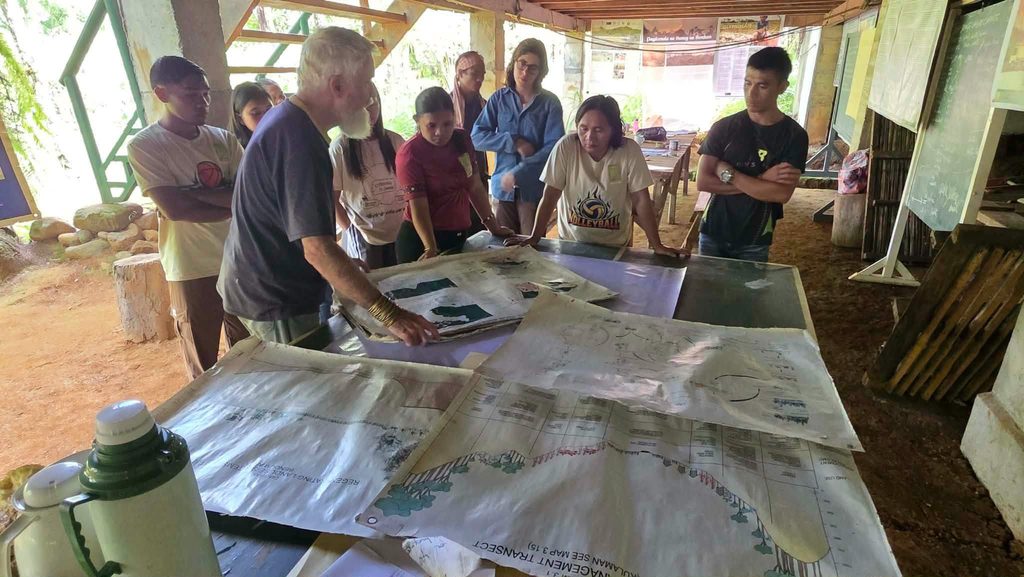
One experience that can be organized with the youth is to start with a past, present and global understanding of what is happening on their lands and in the life around them. Drawing together this story over three days helps in understanding their own environment, local economy, and how these are closely connected to global climate changes experienced locally.
In Bendum, an upland village in Upper Pulangi, Bukidnon, in northeastern Mindanao, Philippines, the story of crop change emerged with the Pulangiyēn, the Indigenous community living in their ancestral domain, and its integral connection with what is happening on a larger scale.
The context of Mindanao’s upland forests includes the period of the government’s Timber License Agreements in the 1970s. Companies bulldozed roads, set up campsites for migrant workers, and extracted wood primarily for plywood manufacturing up to an elevation of 800 meters above sea level. This elevation is where the premontane and mossy forests are found. These forests do not have high economic value but are among the most critical for water generation and infiltration.
Much of the logged-over forest was wasted and later burned by those who stayed after the logging. Transport to the city was generally available for those living along the road. At times, there was some work for local people. Several communities, however, moved their villages away from wherever the camps or new communities were established.
In the Indigenous school operated by the Apu Palamguwan Cultural Education Center (APC) in Bendum, senior high school students conducted a community survey for their research class that showed how food availability shifts to food insecurity during the months of July and December. This is where drought is experienced as a creeping disaster, unlike flooding, and calls for a different approach to disaster risk reduction.
Bukidnon Province is the second-largest producer of corn for livestock feed in the Philippines, and there is an increasing number of animal farms in the area. The corporate drive to grow more corn for livestock feed is high and continues to expand.
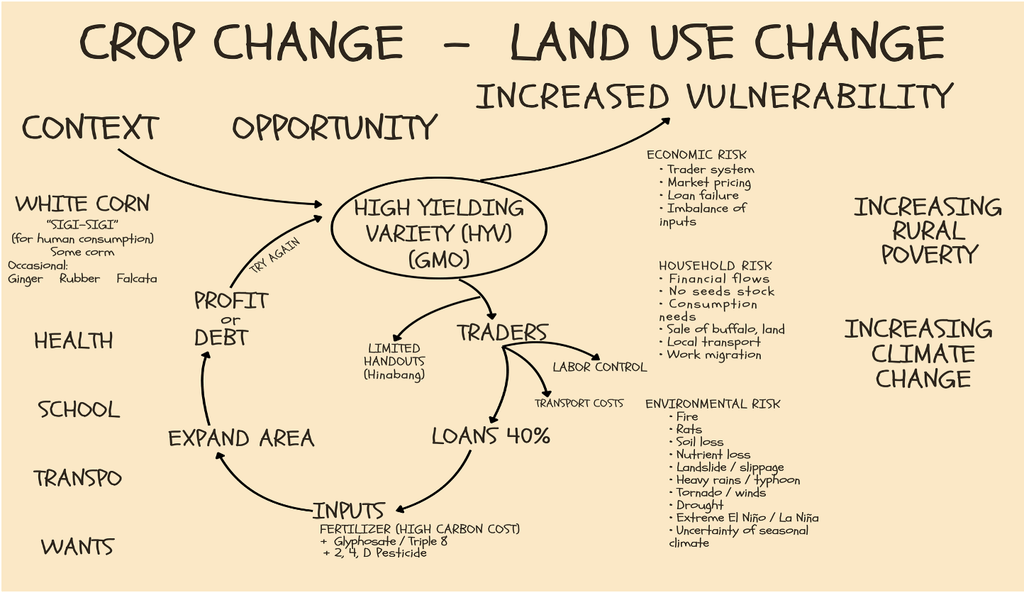
Many farmers in the area grow commercial corn for animal feed, but in many instances, the cash returns from this activity are not sufficient. The family’s food supply is put at risk as the farmer has to buy white corn varieties for human consumption, as well as rice.
Some of the APC school teachers and members of the forest regeneration team put together the story of the last harvest from April to May 2026. High-yielding varieties (HYV) of maize, or corn, and soybean for other farmers are genetically modified organisms (GMOs), in which genetic material, or deoxyribonucleic acid (DNA), is altered to resist chemical herbicides and produce more grain with the use of fertilizers.
Bringing lessons from science class together with community experience can provide valuable learning and raise questions about assumptions and lived experience. These are precisely the decisions people face in daily life as they try to balance competing risks.
Local corn varieties used to be found on small farms until the mid-2000s, when the widespread adoption of GM corn occurred. Local white corn, together with sweet potato and cassava, provided food security, but the promise of cash and the growth in motorcycle ownership, which gave people access to the city at any time, damaged local practices of shared cropping and shared seeds, as well as family financial stability.
Now, the corn grown on farms feeds more pigs and chickens across the Philippines than it does people. Basic food for people is no longer grown, while cheaper rice from Vietnam is imported.
There is only so much these communities can do. Agroecology is not going to solve the problem until the economic model and approach are changed. The situation is disastrous, and corporate agriculture is driven to expand over more land. It is a gamble, and there is no steady growth. One can win big or lose everything.
The southern Philippines, where the Mindanao region is located, is suffering grievously during this year’s long drought periods. People are struggling without fully understanding how to put the story together and what is happening to their knowledge and practices.
Temperature probabilities for August, September and October 2026 highlight the shift toward above-normal temperatures at this time of year. Much of Oceania, Southeast Asia and South Asia are in areas with a 70% probability of above-normal temperatures, which means that an average of 30°C for the high and 20°C for the low can become 38°C during this period, as an example.
The impacts of climate change and land-use change are continuously documented, from the local to the global level. From the stories of communities, especially Indigenous youth, there is a need to understand how they are connecting climate change with the global situation.
This understanding and documentation will then allow for a better presentation of a generation that wants climate stability, and not simply resilience and adaptation, which seem to be prevalent responses imposed by the Global North.
The role of narratives is critical, as there is limited knowledge of what Indigenous communities have achieved. There are also communities of practice working together through multilateral and bilateral collaboration, while calling for technological accountability and building a more integrated voice. There is much work ahead, but there are also many sources of inspiration in the stories of those who share hope, care, and practice grounded in moral and spiritual values.
Fr. Pedro Walpole, S.J. works in sustainable environment and community land management in Southeast Asia, with mainly local communities, universities, international organizations, and governments. He practices a people-focused approach to capacity building and seeks to promote more lasting partnerships through research, consultation, and policy building to support local populations and governments. He is the Coordinator for the River Above Asia Oceania Ecclesial Network. Pedro also directs the Apu Palamguwan Cultural Education Center, an upland basic education program and technical training for indigenous children in northern Mindanao that has its own culture-based curriculum and promotes multi-language education and the use of the mother tongue. He continues to live with the Pulangiyēn, an upland indigenous community in Mindanao.