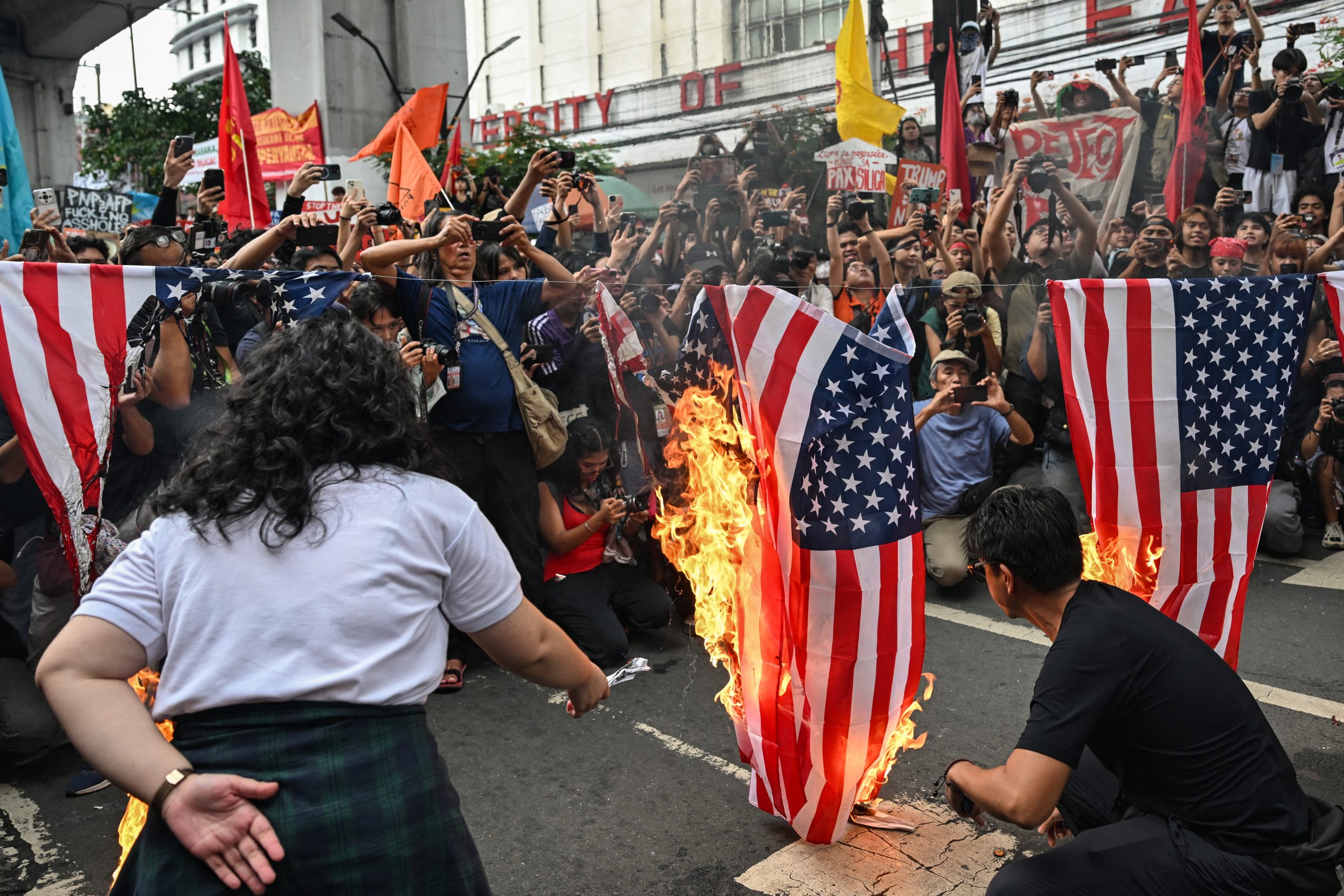
International environmental and human rights groups have called for a United Nations investigation into the Philippine police crackdown on protests against the U.S.-led Pax Silica initiative during President Donald Trump’s visit to Manila, citing mass arrests, alleged police violence, and restrictions on civil liberties.
Friends of the Earth Asia Pacific called on the UN Human Rights Council’s special procedures on Indigenous Peoples, the environment and climate change to monitor and investigate alleged police abuses during demonstrations held alongside the 49th Association of Southeast Asian Nations (ASEAN) Summit.
The network said its Philippine member organization, the Legal Rights and Natural Resources Center (LRC), documented at least 19 incidents of alleged human rights violations from Nov. 13 to 16, including the arrests of at least 297 people.
Those arrested included 40 Indigenous Iraya-Mangyan and Hanunuo-Mangyan people, workers, students, environmental activists, minors, and media workers, according to the organization.
“We urge international human rights bodies, including the United Nations Human Rights Council through its Special Procedures Mandates on Indigenous Peoples, Environment, and Climate, to immediately launch an active monitoring and investigation of the ongoing police brutality against the protest movements opposing Pax Silica,” Friends of the Earth said in a Nov. 17 statement.
The group reported violent dispersals and harassment in Manila, Muntinlupa, Quezon City and Cebu City. It also documented restrictions on travel, alleged vehicle sabotage, food blockades and delays in access to lawyers, medical assistance and representatives of the Commission on Human Rights.
Human Rights Watch (HRW) separately reported that police arrested and detained at least 245 protesters, including 236 people traveling from Southern Tagalog to join demonstrations in Manila.
The detainees included 29 farmers, some of them Indigenous Mangyan, 19 journalists, nine environmental defenders and six human rights workers. HRW also cited information from the National Union of Peoples’ Lawyers (NUPL) that 19 children were detained.
HRW said protesters had been detained for three days without charges. Activists and lawyers reported poor ventilation, insufficient drinking water, and inadequate restroom facilities at the detention site.
The organization also cited footage showing police officers slapping and kicking a protester on the ground during demonstrations in Manila.
HRW called for the immediate release of people arbitrarily detained for exercising their rights, saying international human rights law prohibits indiscriminate mass arrests even when demonstrations violate local regulations or become disorderly.
Altermidya Network, an alliance of independent media organizations, documented alleged police attacks on protesters, journalists and human rights defenders during the demonstrations.
Its consolidated reports included physical assaults, harassment of media workers, attempted arrests of journalists, restrictions on legal assistance and the obstruction of vehicles transporting protesters.
The network reported that police blocked a vehicle carrying more than 300 rice meals, juice packs and bottled water intended for protesters in Manila.
It also documented allegations of damaged vehicle tires and brake hoses, restrictions on access to detention facilities and inadequate food, drinking water and medical assistance for detainees.
International civil society alliance CIVICUS called on Philippine authorities to investigate the reported abuses and hold responsible officers accountable.
“The right to protest is guaranteed in the Philippines constitution and its international human rights obligations. Restricting protests at the ASEAN summit, arresting, and harassing protesters are a clear violation of Philippines’ human rights commitments. The authorities must ensure all those arrested are released and any charges against them dropped,” said Josef Benedict, CIVICUS Asia-Pacific researcher.
CIVICUS also raised concerns over reports that protesters held at Camp Bagong Diwa in Taguig City were denied access to legal counsel.
“It is outrageous that detained protesters were denied access to lawyers by the police, a violation of due process rights. It is also extremely worrying that journalists were targeted for their reporting. This must be immediately investigated by the authorities,” Benedict said.
The Armed Conflict Location & Event Data Project (ACLED) said opposition to Pax Silica had prompted demonstrations across the Philippines months before Trump’s arrival.
“ACLED data show at least 24 anti-Pax Silica protests in the Philippines from 22 April onwards ahead of Trump’s November visit, with the count expected to rise,” said Tomas Buenaventura, ACLED’s Asia-Pacific analyst.
Buenaventura said the number of arrests during the ASEAN summit exceeded those recorded during the Sept. 21, 2025, anti-corruption demonstrations.
NUPL condemned the Nov. 15 arrests of protesters, including participants in a caravan known as Lakbayan.
The lawyers’ group alleged that detainees were subjected to physical and verbal harassment, inadequate detention conditions, and restrictions on access to legal counsel, food, and family members.
“The right to peaceful assembly is a constitutional guarantee rooted in freedom of expression,” NUPL said.
The United Church of Christ in the Philippines (UCCP) demanded the release of four of its young members and other protesters detained at Camp Bagong Diwa and the Manila Police District.
In a Nov. 18 pastoral appeal, UCCP bishops questioned the legality of the warrantless arrests and continued detention, citing constitutional protections for peaceful assembly, due process, and freedom of expression.
The bishops also raised concerns over restrictions on access to lawyers, medical assistance, and family members.
The protests opposed the Philippine government’s plan to establish a technology manufacturing hub in Capas, Tarlac province, under Pax Silica, a U.S.-led initiative to develop supply chains for critical minerals, semiconductors and artificial intelligence technologies.
HRW warned in a separate report that the proposed project would displace hundreds of Indigenous people and small farmers from their homes and agricultural lands.
Friends of the Earth said the manufacturing hub would occupy land claimed by Indigenous Ayta communities within the New Clark City economic zone.
The network warned that mining and industrial development linked to Pax Silica could threaten other ancestral territories, particularly areas where approved mining projects overlap with Indigenous lands.
Friends of the Earth said 11 member organizations across the Asia-Pacific region, including Palestine, had joined efforts to monitor the protests and support affected communities.
The network also urged diplomatic missions to raise concerns with the Philippine government over the treatment of protesters and called for international scrutiny of the police response.