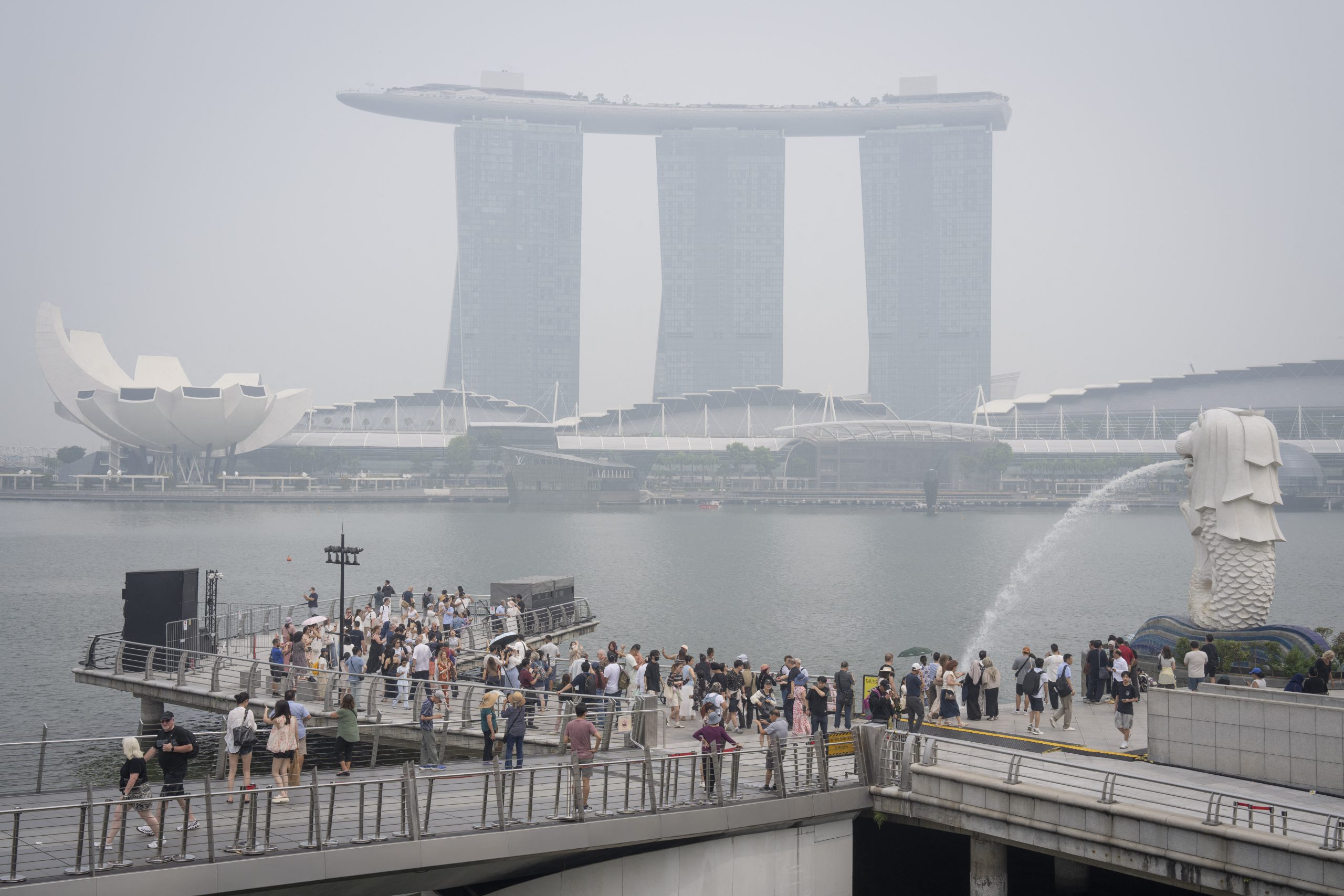
Singapore’s tougher haze law now reaches the banks and investors behind companies linked to the forest fires in Indonesia. For the Catholic Church in Singapore and its neighbors, that raises a question closer to home: where does the Church’s own money go?
The amendments to the Transboundary Haze Pollution Act, passed on Nov. 4, allow fines of up to S$20 million and let the government bar firms linked to the fires from loans and other financial services, AsiaOne reported. On Oct. 23, the National Environment Agency issued notices requesting information to 10 Singapore-registered companies, including Asia Pulp & Paper Company Limited, Golden Agri International Pte Ltd and Wilmar International Ltd. The notices are requests for information, not findings against the companies.
Between Nov. 7 and Nov. 14, all 32 Catholic churches in Singapore were asked to share their latest income and expense statements, as shown to parishioners. None did. St. Joseph’s Church (Bukit Timah) declined to comment, Novena Church said it had “no comment to offer,” and the Church of St. Ignatius asked that inquiries be directed to the archdiocese. Most of the others did not respond.
Parishes were meant to be open about their money. In 2018, Monsignor Philip Heng, then vicar general for administrative and financial matters, wrote in CatholicNews: “Parishes have also been disclosing to their parishioners their income and expense statements since 2016.”
The archdiocese’s own accounts, filed with the Commissioner of Charities, show its legal entity held S$402.9 million in investments at the end of 2025, including S$137.3 million in bonds and S$13.5 million in shares. The accounts do not name the bond issuers, the shares held or the fund managers.
Asked whether it screens its investments for companies linked to the fires, the archdiocese’s Media Relations Office said its investment practices “take into consideration relevant guidelines and requirements prescribed by both applicable civil authorities and the Holy See.” It said it would not comment further.
“I am not sure if the archdiocese has any ethical investment policy in place,” said Friar John Paul Tan, 65, a Franciscan who has served the archdiocese as chancellor and vicar general. “At the minimum, there should be in place an investment policy for all Catholic charities that do investments for their funds.”
The Catholic charities give a similar picture. Caritas Singapore said its funds are managed by BNP Paribas Singapore under a mandate that excludes gambling, alcohol, tobacco, weapons and pornography, but not palm oil or pulp and paper.
Catholic Welfare Services said it takes “a prudent approach to investment, with our focus firmly on capital preservation,” but was “unable to share further details of our internal investment policy or individual investment holdings.”
Assisi Hospice placed its funds with three fund managers, its 2025 annual report says. One of them, Schroders, said it “does not comment on client relationships or specific portfolio holdings.”
Only one set of accounts reviewed, from the Franciscan friars’ registered charity, names its holdings: two Singapore bonds issued by Keppel Corp. and Mapletree Treasury, neither of which was among the companies served notices.
Across the region, pressure on the money behind the fires is growing. Singapore’s central bank said on Oct. 28 that banks are expected to ask agribusiness clients whether they prevent, detect and stop fires, Green Central Banking reported.
On Oct. 27, Indonesia and Singapore agreed on a joint task force to trace the companies through financial intelligence. “Smoke can cross borders, so can money,” Indonesian Foreign Minister Arrmanatha Nasir said, Indonesia Business Post reported.
At the ASEAN summit in Manila on Nov. 15, Indonesian President Prabowo Subianto said the haze was “not our fault,” but apologized “if we have created suffering for the people of Singapore and Malaysia,” The Philippine Star reported. Singapore Prime Minister Lawrence Wong said: “We will share information, we will take action, and we will hold companies responsible,” Yahoo News Singapore reported.
Across the causeway, the Church has made a commitment. In July 2023, Malaysia’s Catholic bishops signed the Ecological Diocese Pledge, under which dioceses commit to “divest from all ecologically harmful investments,” including “deforestation (logging, timber, oil palm),” said G. Clare Westwood, regional director of the bishops’ Creation Justice Commission for Malaysia, Singapore and Brunei. Companies causing the haze would qualify, she said, though not all palm oil and pulp and paper firms are “responsible for the forest fires.”
Justin Sentian, 55, a professor of climate change at Universiti Malaysia Sabah and a member of the Creation Justice Commission of the Archdiocese of Kota Kinabalu, said Church bodies “should absolutely conduct due diligence checks” before choosing banks and fund managers. The checks, he said, should be “practical” and not demand “absolute perfection.”
From Central Kalimantan, where the fires burn, Frans DS Sani Lake, 55, director of JPIC Kalimantan, urged Church bodies to ask their banks and fund managers about links to the companies. “If no honest answer comes, move your money,” he said.
Church leaders in Singapore have set the standard themselves. In 2017, Archbishop William Goh told parish priests and finance staff: “We are stewards of God’s money, of people’s money. The money is not for ourselves, it is meant for the common good,” CatholicNews reported.
And in 2021, Archbishop Marek Zalewski, the apostolic nuncio to Singapore, told a climate conference in Singapore that “all decisions about the environment are moral.” The nunciature said on Nov. 12 that questions should be addressed to Cardinal Goh.
“Where does the money come from, and where does it go?” asked Michel Chambon, 45, a cultural anthropologist and former research fellow at the National University of Singapore’s Asia Research Institute. “Jesus offers us some very clear recommendations on this matter in the Gospels.”