
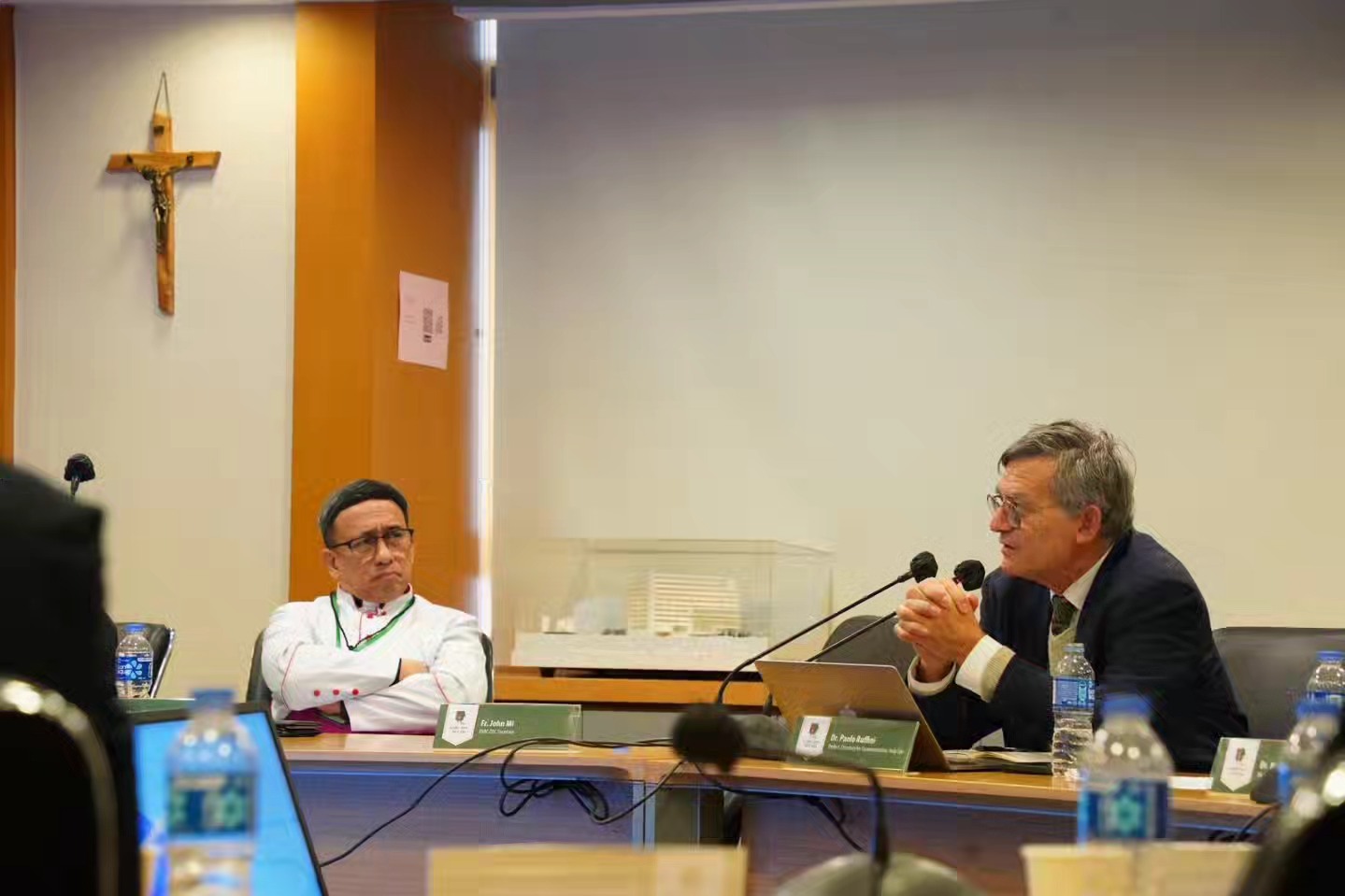
A Vatican official has warned Asian Church leaders that artificial intelligence (AI) must never be allowed to replace human wisdom or diminish the dignity at the heart of Christian life.
Dr. Paolo Ruffini, prefect of the Dicastery for Communication, urged bishops to approach the technology with moral clarity and disciplined discernment during the Bishops’ Meet 2025 at St. Francis University in Hong Kong on Dec. 10.
The three-day assembly was organized by the Office of Social Communications of the Federation of Asian Bishops’ Conferences.
Fr. Joseph Anucha Chaiyadej, executive director of Catholic Social Communication of Thailand, observed that this year’s Bishops’ Meet is taking on a wider range of concerns.
“I noticed that the theme in the invitation letter seemed narrower, beginning with challenges in Asia, but the conversation has now widened to the impact on humanity as a whole,” he said.
Ruffini said the Church’s reflection on AI must begin with a clear understanding of the human person, warning that technology is reshaping communication, culture, and relationships in ways that demand ethical vigilance.
He reminded participants that the Church now faces both “a great opportunity and a tremendous responsibility,” according to a Radio Veritas Asia report.
While AI can support “reasoning, context, summarizing, research, and translation,” Ruffini stressed that “true wisdom cannot come from machines and algorithms.”
Treating AI as capable of total knowledge, he said, risks repeating the temptation “to be like God.”
He added that intelligence itself “cannot be artificial,” describing current systems as “calculation” or “a statistical gamble,” often concealing errors or the interests of their creators behind an appearance of neutrality.
Ruffini said the primary risks come not from technology but from “those who own them, those who programme them and those who use them.”
Citing computer scientist Ken Thompson, he raised concerns about the limits of trust in code, stressing the need for ethical safeguards so AI becomes “an extraordinary opportunity and not its exact opposite.”
Fr. Anucha said collaboration across Asia will be essential as Church media offices navigate these shifts.
“Media work is something that must always be updated,” he said. “After the fog of conflict in some Asian media circles has passed, it is time for us to cooperate, move forward, and walk together.”
Ruffini warned that AI-generated content risks eroding the depth of relationships and the time needed for authentic human experience.
He said technology can isolate individuals and hinder their ability to meet others meaningfully.
He pointed to the growing threats posed by deepfakes, unverifiable sources, algorithmic filtering, and opaque digital systems that shape what users see.
These structures, he said, trap people in “filter bubbles” driven by commercial or ideological interests.
Dominant AI models, he added, shift attention “from quality to speed and from real knowledge to attention-grabbing content,” undermining freedom of thought and the integrity of information.
Ruffini echoed Pope Francis’ call for strong media and AI literacy to ensure that “the human heart itself” does not become artificial.
He noted that Pope Leo XIV has urged young people not to let algorithms “write their story,” encouraging them to humanize the digital world and cultivate moral discernment.
Fr. Anucha said the meeting will help strengthen cooperation among Asian Catholic media offices, adding that Thailand has “nothing to worry about, but the information we expect to bring back, combined with cooperation and connection, will make next year another year in which we can use media to build collaboration.”
Ruffini urged the Church to rebuild trust in its communication networks and cultivate an ecosystem grounded in truth. Artificial intelligence, he said, must never “replace us” or dictate the course of human history.
True efficiency, he told participants, lies not in speed but in drawing meaning from the time given. The Church, he said, must be “salt and leaven,” shaping a communication culture that protects human dignity and serves the common good.









