
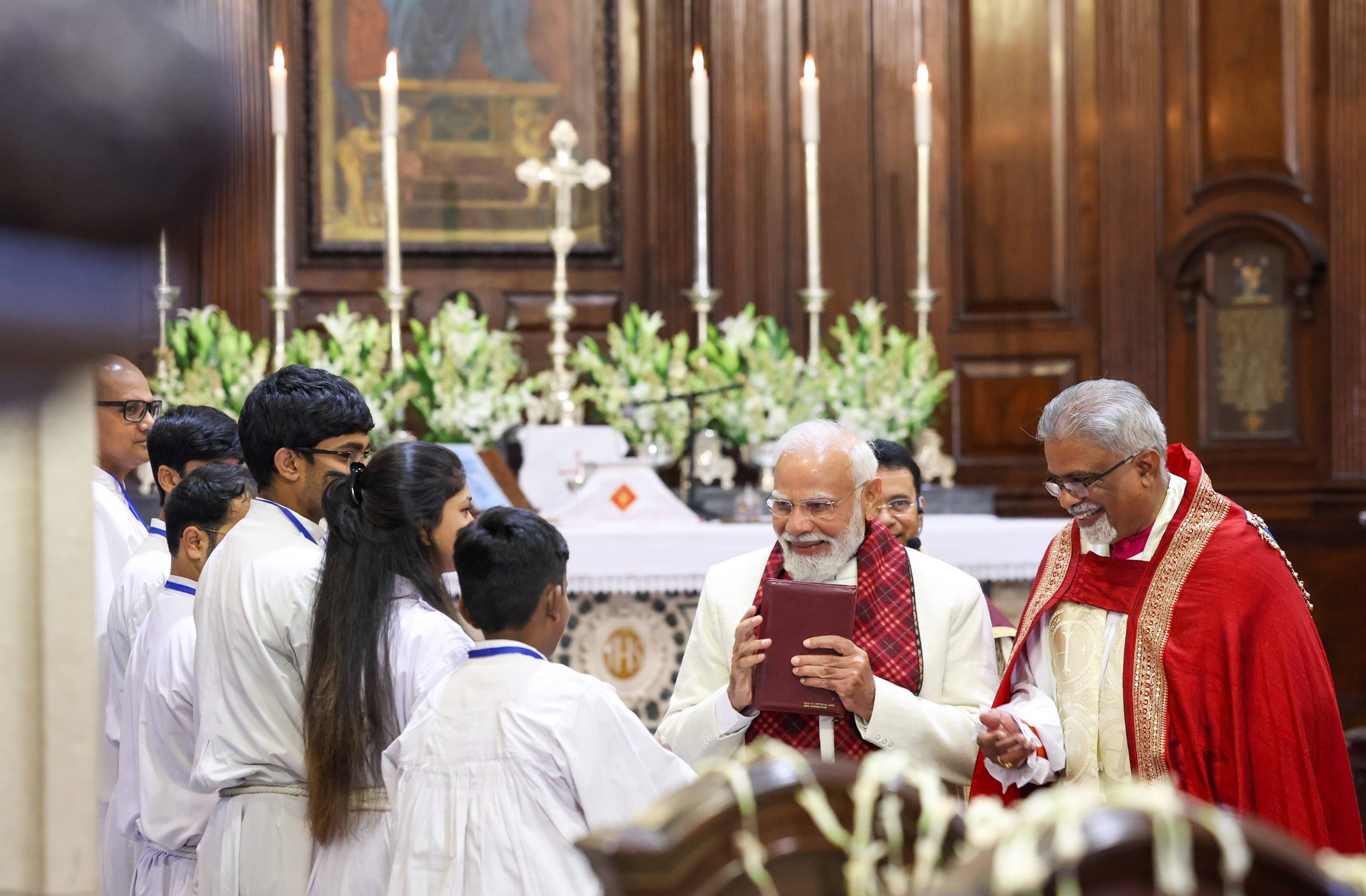
Public gestures of religious inclusivity by Indian Prime Minister Narendra Modi, including his attendance at Christmas celebrations in churches, contrast sharply with continued attacks against Christian communities across India.
In a reflection published by Asianews, Bishop Savio Fernandes, auxiliary prelate of Mumbai, examined the widening gap between the prime minister’s highly publicized outreach to Christians and reports of violence targeting Christian institutions and worshippers across the country, often during the same period.
In recent years, Modi has repeatedly reached out to India’s Christian community, particularly around Christmas, by visiting churches, hosting meetings with Christian leaders, and publicly acknowledging the community’s contribution to education, health care, and charitable service.
These appearances, broadcast on national television and widely shared on social media, Fernandes wrote, project “an image of inclusiveness and goodwill.”
Yet, he noted, these moments are frequently followed, sometimes even on the same day, by reports of attacks against churches, prayer halls, convents, schools, and peaceful worship gatherings in various parts of the country, a contradiction that continues to fuel anxiety among Indian Christians.
“This disturbing contradiction has led many to ask an uncomfortable question: Is Prime Minister Modi a weak and impotent leader, unable or unwilling to exercise control over elements within his own ideological camp?” Fernandes said.
Citing data from independent civil society organizations and human rights groups, the bishop said recent years have seen a significant increase in harassment, disruption of prayer services, vandalism of religious sites, and intimidation of clergy and faithful.
He stressed that these incidents are not isolated or accidental, but follow a pattern suggesting ideological hostility rather than spontaneous public order problems.
The victims, he said, are “a nonviolent, peaceful, law-abiding, service-oriented, and friendly minority,” whose institutions have long served people of all faiths without discrimination.
Fernandes also raised concern over what he described as the apparent impunity surrounding the attacks, noting that some occur in the presence of law enforcement officers who remain passive.
When perpetrators openly identify with groups drawing ideological inspiration from the broader political family associated with the current government, he said, they are not only targeting a minority community but also challenging the prime minister’s authority.
“A strong leader would respond to such a challenge with moral clarity,” Fernandes said, adding that “what is most striking is the prime minister’s persistent and deafening silence.”
He said that “no direct public instructions have been issued to contain the violent elements, no firm words of condemnation have been uttered for the attacks on churches, nor has reassurance been offered to a fearful community that looks to the highest constitutional office for its protection.”
The bishop cited one particularly disturbing incident in which an attacker insulted the Virgin Mary and used obscene language toward a woman, including questioning her about how she becomes pregnant.
Such behavior, he said, reflects “profound moral degradation and contempt for women and faith,” and the lack of strong government response risks sending “a dangerous message of tacit approval.”
Fernandes stressed that condemning violence should not be viewed as hostility toward the government or the prime minister, but as a matter of constitutional accountability.
India’s Constitution, he noted, guarantees freedom of religion and the right to practice religion without fear, and continued silence in the face of violations erodes public trust.
At the same time, he acknowledged expressions of solidarity from religious leaders, civil society members, journalists, ordinary citizens, and some political figures who condemned the Christmas-season attacks, saying such responses show that “India’s soul is still alive and that moral courage has not been extinguished.”
Christians in India, Fernandes added, are not seeking privilege but equal treatment under the law, while continuing to educate millions, care for the sick, and serve the poor, often in areas where the state itself struggles to reach.
The reflection concluded with a call for leadership that goes beyond symbolic gestures. “Calling an act of violence violence isn’t an act of enmity,” Fernandes wrote. “It’s a gesture of hope.”