
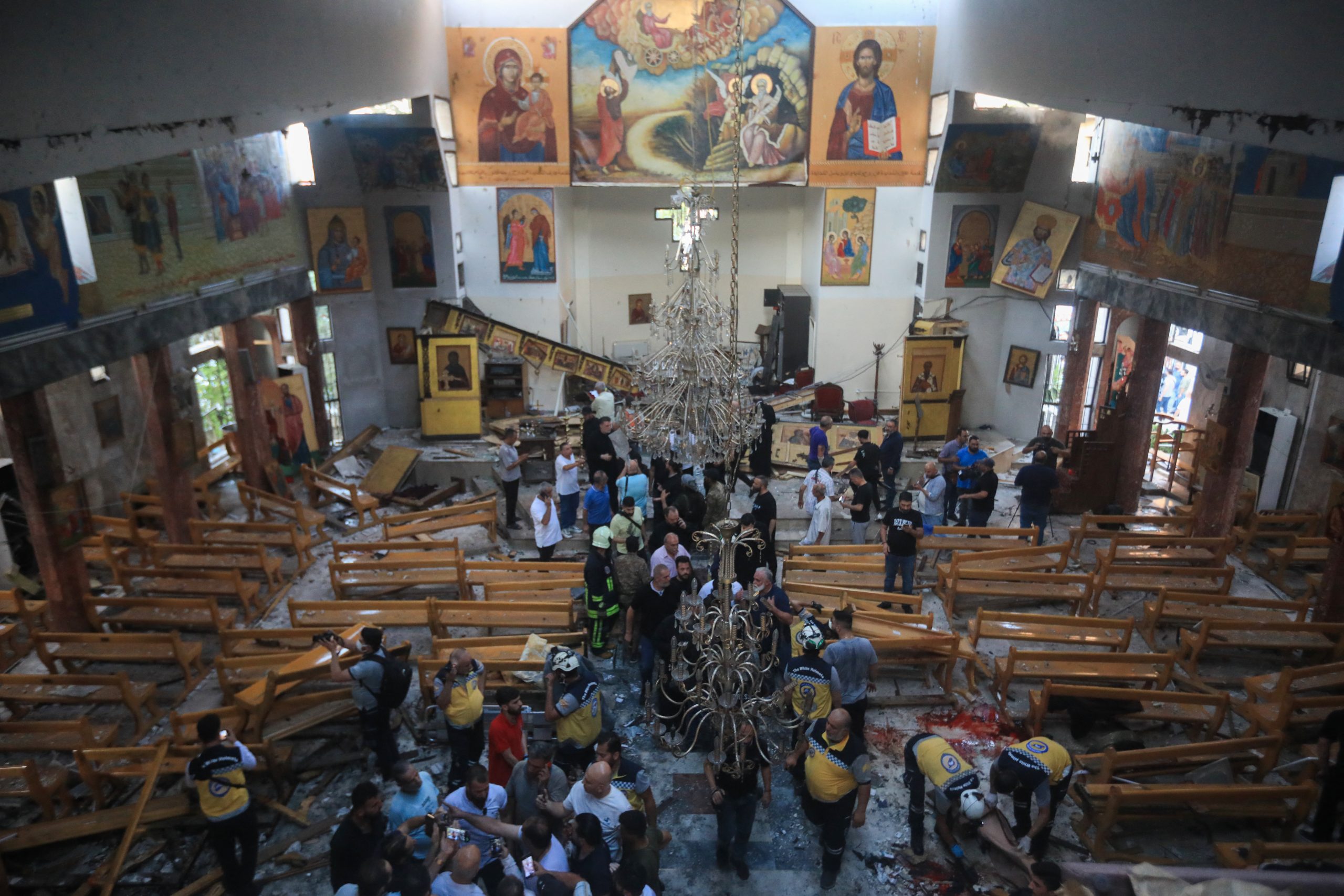
Syrian authorities have released a detailed account of the June 22, 2025, suicide bombing at the Greek Orthodox Church of Mar Elias in Damascus that killed at least 25 worshippers during the Divine Liturgy.
In a lengthy statement supported by video footage, the Syrian Ministry of Justice said it had identified both the organizers and perpetrators of the attack, reaffirming their affiliation with the so-called Islamic State since 2017.
The attack targeted worshippers gathered inside the Mar Elias church. In the immediate aftermath, representatives of the government led by Ahmed al-Sharaa pointed to unspecified Islamic State cells as responsible, although the group did not claim the attack, Fides News Agency reported.
Responsibility was instead claimed by Saraya Ansar al-Sunna, a group founded shortly after the fall of the Assad regime, which justified the bombing as “punishment” after an alleged “provocation” by Christians in Damascus against “the people of faith.”
Nearly eight months later, the ministry’s report said the cell behind the bombing was swiftly identified and had received “precise orders to carry out a coordinated operation,” targeting both the Mar Elias church during a liturgical celebration and the Sayyida Zainab Islamic mausoleum using bombs and suicide belts.
According to the report, based on interrogations of arrested accomplices, investigators reconstructed the distribution of roles in planning the attacks, as well as the preparation, assembly, and transport of the explosives.
Authorities presented the findings as evidence of the new Syrian leadership’s determination to prosecute those who attack Christian citizens.
The release of extensive details, however, has prompted skepticism from some observers. A statement published by SyriacPress said, “From the Ministry of Justice’s point of view, this rapid succession of events serves as proof of the ‘state’s ability to identify the true perpetrators’ and that extremist organizations remain under close surveillance.”
The same statement added that “in a country where public opinion is accustomed to lengthy and discreet security investigations, the rapid emergence of such comprehensive results has seemed to many closer to a rushed dossier than the actual dismantling of a network.”
It also questioned the official account’s “reference to ‘leaders within the organization’ without naming them, to funds transferred without clarifying their origin, and to explosive materials stored in private homes without explaining how these steps went unnoticed.”
While the Ministry of Justice said investigations are ongoing, and suspects will be brought before the courts, the statement stressed that “the transmission of confessions does not replace a public trial, nor does it exempt the authorities from providing broader disclosure of the chain of responsibility, including administrative and security responsibilities.”









