
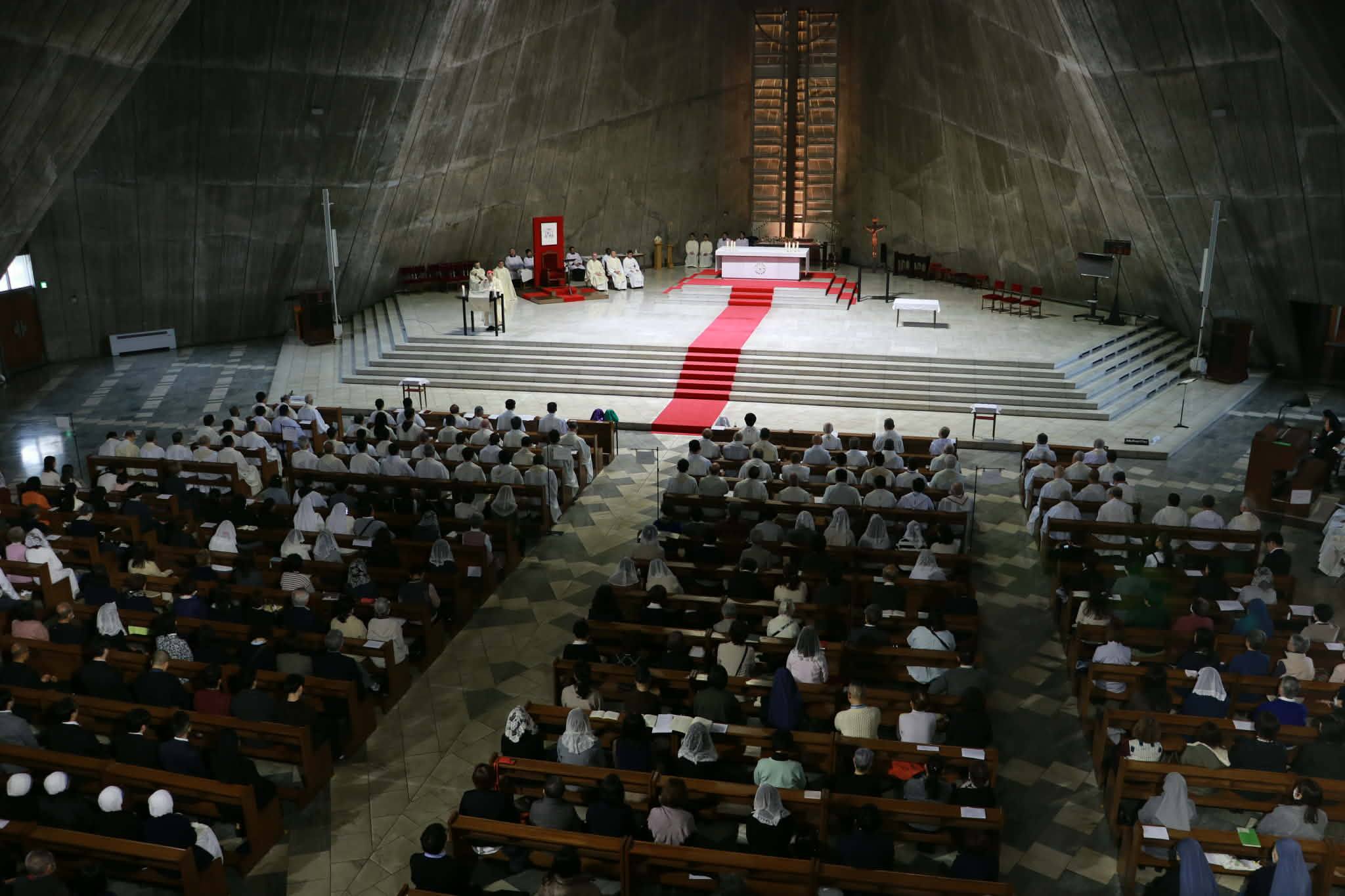
Cardinal Isao Kikuchi of Tokyo on Holy Thursday urged priests to take the lead in rebuilding human connections in a society marked by isolation, warning that faith risks becoming abstract unless it is rooted in real encounters that generate hope.
Speaking at the Chrism Mass on April 2 at St. Mary’s Cathedral in Tokyo, Kikuchi said that “in today’s society, where concrete human relationships are becoming increasingly tenuous,” the Church must respond by fostering “tangible, concrete encounters and interactions” that sustain faith and community.
Drawing on Deus Caritas Est, he said Christian life is not a system of ideas but a relationship, stressing that it is not “ethical choices or lofty ideas” that define belief, but “an encounter with an event, an encounter with a person.”
He linked this to lived experience, recalling how Pope Francis told survivors of Japan’s 2011 disaster that “No one can ‘recover’ alone,” underscoring that human connections are essential to restoring hope.
In a society marked by isolation, Kikuchi said the Church must resist becoming a place shaped by division, insisting that “our church is not a place of conflict” and “not a place that breeds despair,” but one that ensures “God’s love reaches all people through the practice of love” and helps generate “hope for living life.”
He pointed to Christ’s identification with those in need, saying that encounters with “the hungry, the thirsty, the strangers, the naked, the sick, and the prisoners” are encounters with Christ himself, leading believers toward hope and deeper faith.
Citing Pope Leo XIV, Kikuchi said the Church’s mission is inseparable from its commitment to the marginalized, noting that “the Church’s love for the poor is essential” and that “the poor are not a sociological category but the very body of Christ (110).”
He situated this mission within a world marked by conflict and inequality, echoing the pope’s warning about “many discords and many wounds caused by hatred, violence and prejudice” and economic systems that “marginalize the poorest of people,” and urging the Church to act as “a little leaven in this dough of unity, fellowship and brotherhood” to help “build a new world where peace prevails.”
Within this context, Kikuchi said priests must take a leading role, stressing that “priests, as shepherds of God’s people, must stand at the forefront, taking the lead in generating hope,” guiding people toward “a personal encounter with Jesus” and helping communities “let that hope burn brightly in solidarity.”
He added that this mission cannot be reduced to preaching alone, saying “the evangelization must not merely be preached, but must be conveyed through witnessing by actions,” and warning that those who foster encounters must not be “utterers of empty words” but witnesses through “loving service.”
About 130 priests from the Tokyo Archdiocese concelebrated the Chrism Mass, renewing their priestly promises alongside religious and lay faithful, while seminarians were instituted into ministries as part of their formation.
Kikuchi closed by urging continued prayer for clergy and seminarians, saying that “the power to create a church community that walks together comes from your prayers” as the Church continues “bearing witness to caritas.”









