
A three-day Catholic education workshop in the Diocese of Timika ended April 16 with a call for stronger collaboration between Church, government, and communities to address deepening challenges in Papua’s education sector.
The gathering brought together around 120 participants and concluded with a shared push to reframe education not only as academic instruction, but as the formation of the whole person rooted in culture, values, and social responsibility.
Deputy Regent of Mimika Emanuel Kemong said the workshop must not be reduced to a ceremonial exercise but serve as a platform for concrete action.
“This is a space for the encounter of ideas and shared struggles—a place where we reflect on the future of Catholic education in Papua,” he said.
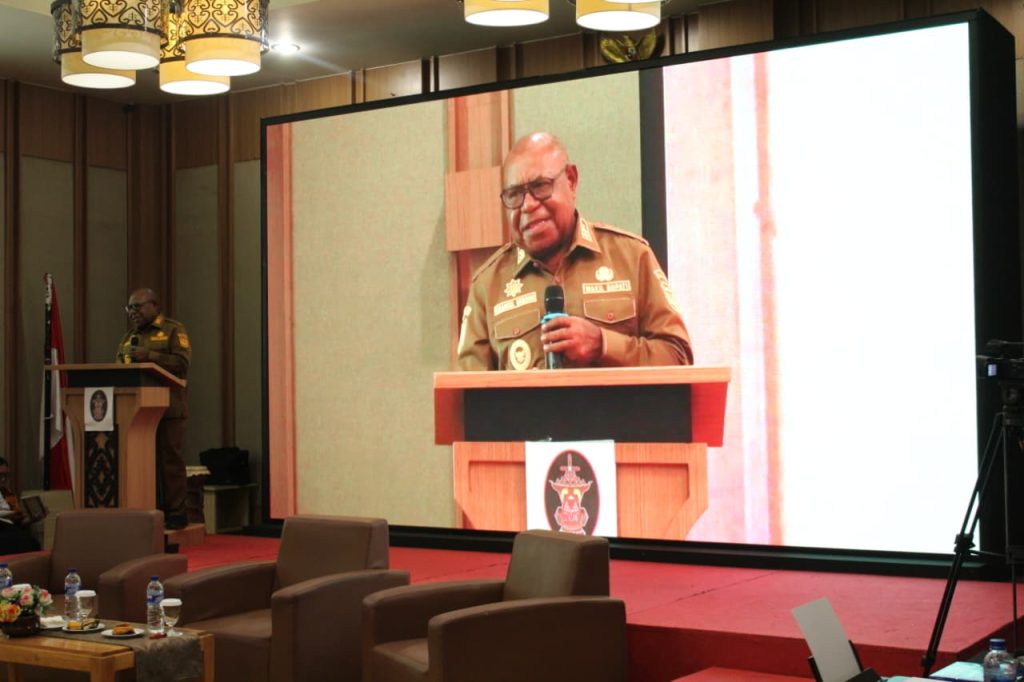
Photo credit: Timika Diocese
Kemong warned against limiting education to academic outcomes alone, stressing its role in shaping human dignity and values.
“Education is not just about transferring knowledge, but about humanizing the human person. We are called to build character and instill noble values in the next generation,” he said.
He added that the local government remains committed to working “in synergy” with the Timika Diocese and other stakeholders to improve education outcomes.
Critique of current education model
Bishop Bernardus Bofitwos Baru of Timika raised concerns over what he described as a growing distortion in the purpose of education, driven by economic priorities.
“Education today tends to produce workers for economic gain. Material and money have become the primary focus, no longer noble values,” said the bishop, the second Indigenous Papuan bishop in the region.
He said the system places excessive emphasis on cognitive learning, often neglecting emotional and practical development.
The bishop also criticized what he called an “employment mindset disease,” where education is pursued mainly for status rather than personal growth.
Ground realities in remote communities
Participants highlighted severe challenges in remote areas, including teacher shortages and student dropouts.
Father Andreas Madya Ariyanti, SCJ, cited cases in coastal regions such as Kokonao, where a single teacher handles all grade levels from Grade 1 to Grade 6.
Data from the Central Papua Provincial Education Office show persistent issues, including teacher absenteeism, school closures, and students leaving school due to armed conflict and alcohol abuse.
Kemong described the situation as a troubling paradox.
“In the past, despite limitations, education was carried out with a strong sense of responsibility. Now, with far better facilities, quality should improve—but reality tells a different story,” he said.
Push to root education in local culture
Dr. Albertus Heriyanto, a lecturer at the Fajar Timur School of Philosophy and Theology, urged a shift toward culturally grounded education.
He said Catholic schools must strengthen, not erase, Papuan identity.
Proposals from the workshop included:
- Using local languages in early education
- Turning natural environments such as mangroves and rivers into learning spaces
“The future of education is when Papuan children do not have to abandon their identity in order to become educated,” he said.
He added that teachers must act as “cultural actors” who build meaningful relationships with students, not merely implement administrative tasks.
Commitment to concrete action
The workshop ended with a commitment to build “concrete synergy for education in Central Papua,” involving Church institutions, government agencies, and private partners.
Bishop Bernardus expressed hope that the discussions would lead to sustained collaboration and measurable change.
“We have identified various problems and formulated strategic steps. Now is the time to walk together so that this spirit does not fade, but bears real fruit,” he said.
He also called for strengthening the Catholic education foundation YPPK through cross-sector cooperation.
Support for the workshop came from the Mimika Regency Government and PT Freeport Indonesia, which contributed funding, accommodation, and logistics.
The bishop closed the gathering with an appeal to turn commitments into action.
“We want the face of the Timika Diocese to become more joyful, where children receive better education. May God bless our steps in building future generations,” he said.
The workshop’s conclusion signals renewed efforts to build an education system in Papua that is both culturally rooted and responsive to present-day challenges.