

At a time when religious architecture is often associated with grandeur and striking visual forms, the Divine Mercy Chapel on the eastern outskirts of Bangkok is drawing attention for a very different reason: its quiet simplicity and strong commitment to sustainability.
Located in Bang Bo District and designed by the architectural firm all(zone), the chapel reflects the ecological vision of Laudato Si’, the landmark encyclical of Pope Francis on care for creation and social responsibility.
For Fr. John Wirach Amornpattana, C.Ss.R., the Redemptorist priest behind the project, sacred architecture should not be defined by extravagance but by how well it serves people and the environment.
“The chapel is grounded in the principles of Laudato Si’,” Fr. Wirach explained. “Sustainability is not an image to be projected, but an ethic to be practiced.”
That philosophy shaped every aspect of the project, from material use and budgeting to ventilation and spatial design.
A Chapel Within a Community Vision
After years of ministry at Holy Redeemer Church in central Bangkok, Fr. Wirach was entrusted by the Congregation of the Most Holy Redeemer with land in Bang Bo to serve a growing suburban community.
Rather than building a large monumental church, he envisioned a broader, community-centered development that would include a school for children, housing for elderly residents, and a chapel integrated into this wider mission of care.
From the beginning, the chapel was conceived not as a stand-alone architectural statement, but as part of a larger ecosystem of education, pastoral outreach, and social support.
Fr. Wirach’s understanding of church architecture has been shaped by his travels in Europe and his pastoral experience in Thailand.
Unlike traditional Catholic churches that emphasize domes and elaborate symbolism, he believes sacredness is expressed more through service and pastoral care than spectacle.
“Faith is not primarily declared through form, but practiced through action,” he said.
Lessons From the Pandemic
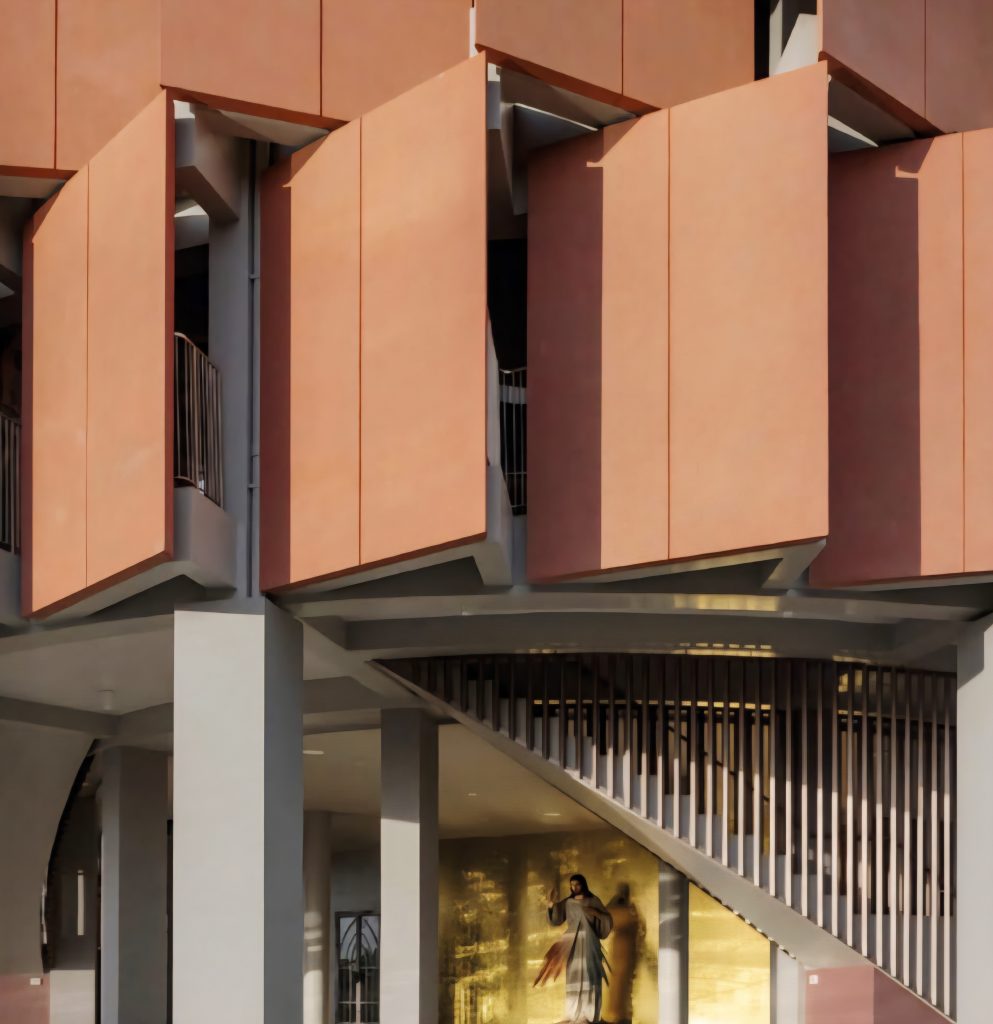
passive environmental strategies while staying economical and practical to construct. Photo credit: all(zone)
The COVID-19 pandemic reinforced Fr. Wirach’s thinking about architecture and resilience.
He observed that churches dependent on enclosed, air-conditioned spaces often struggled during the crisis, while naturally ventilated buildings were able to continue serving their communities more effectively.
As a result, one of the chapel’s boldest design decisions was made: the building would have neither conventional windows nor air-conditioning systems.
The choice was not simply aesthetic. By reducing construction and operational costs, more resources could be directed toward education and social programs.
At the same time, the open-air design aligned closely with the environmental principles of Laudato Si’.
“The chapel would not merely symbolize care for creation,” Fr. Wirach said. “It would enact it.”
Designed for Climate and Community
The architectural challenge was to create a building that remained comfortable through passive environmental strategies while staying economical and practical to construct.
After extensive studies of airflow, daylight, and rain protection, all(zone) developed a double-ring cylindrical structure.
The outer ring functions as a circulation space, while the larger inner ring houses the worship area and altar.
The design allows natural cross-ventilation from every direction, reducing dependence on mechanical cooling while creating an open and welcoming atmosphere.
Natural daylight enters through elevated openings and is softened by large structural beams above the altar and seating area, producing a calm and contemplative interior.
The chapel is enclosed by 72 precast concrete panels installed at carefully calculated angles to filter sunlight, reduce heat, and protect against rain while allowing airflow throughout the building.
Although computerized environmental simulations were used to minimize rainwater entering circulation areas during Thailand’s monsoon season, Fr. Wirach remained pragmatic about occasional discomfort.
“For a few days of rain each year, a mop is enough,” he remarked, emphasizing that openness and simplicity were more important than total environmental control.
A Quiet but Powerful Witness
Rather than seeking attention through monumental design, the Divine Mercy Chapel offers a different understanding of sacred architecture rooted in care, responsibility, and community life.
Its significance lies not in visual extravagance but in how it responds to human and environmental needs with humility and intelligence.
In a society where architectural importance is often measured by spectacle, the chapel stands as a quiet but powerful reminder that meaningful architecture does not always need to appear extraordinary.