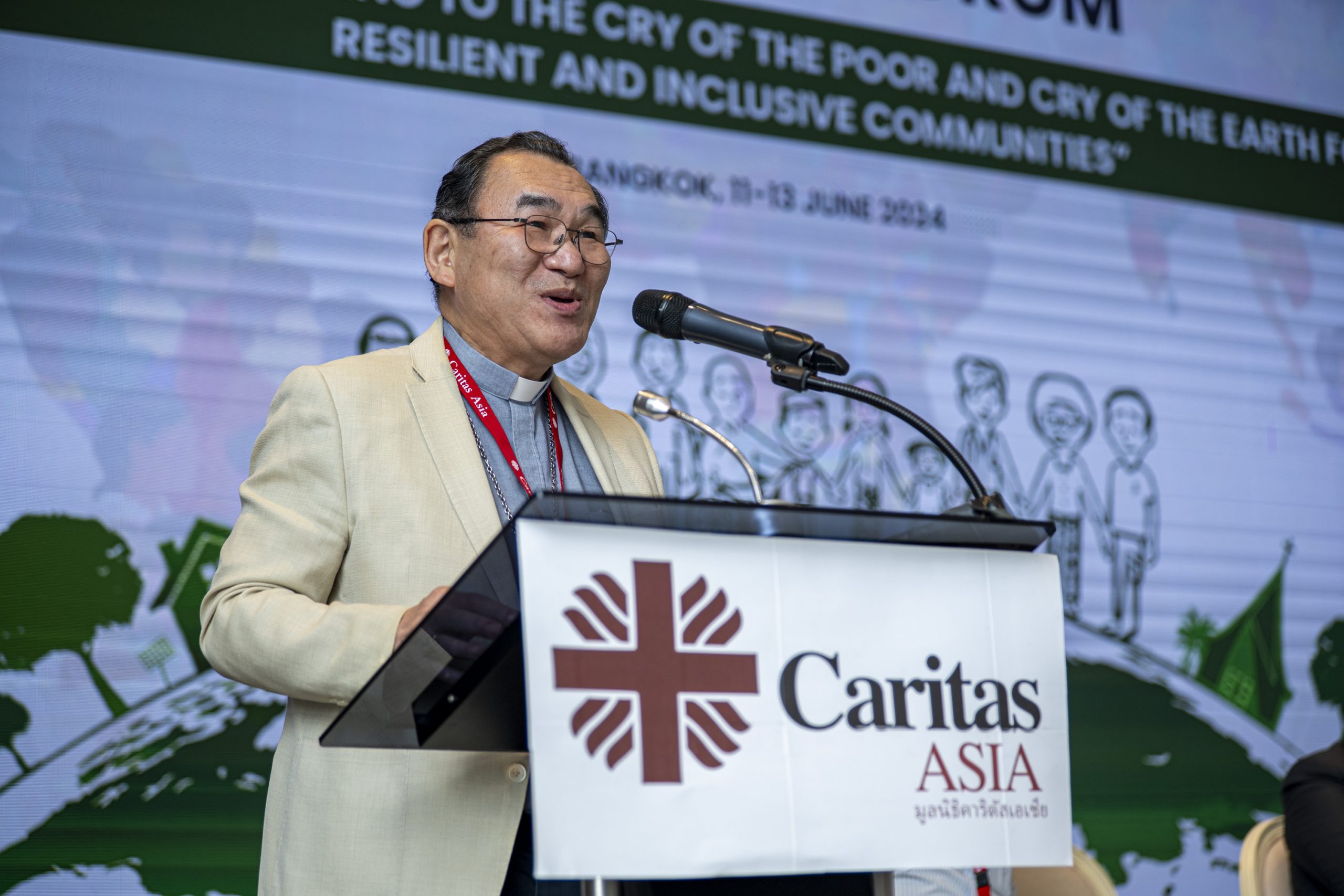
Cardinal Isao Kikuchi urged G7 leaders to place human dignity at the center of policymaking as world powers confront war, migration, climate change, inequality, and the rapid expansion of artificial intelligence.
The appeal came ahead of the G7 summit in Evian, France, from June 15 to 17 and accompanied a joint statement issued by the presidents of the Catholic bishops’ conferences of the G7 countries and endorsed by the president of the Commission of the Bishops’ Conferences of the European Union.
Kikuchi, archbishop of Tokyo, president of the Catholic Bishops’ Conference of Japan, and president of Caritas Internationalis, said the Church has a responsibility to speak to political leaders at a time of growing global instability.
He told worshippers during a Mass at St. Mary’s Cathedral on June 14 that he participated in drafting the statement alongside the heads of the bishops’ conferences of Canada, France, Germany, Italy, the United Kingdom, and the United States.
“It is also the church’s duty to appeal to the political leaders who will be gathering at the G7 Summit (Meeting of the Heads of State of Major Nations) in Evian, France, from June 15th to 17th this week,” he said.
The joint statement calls on G7 governments to reaffirm their commitment to multilateral cooperation, international law, peaceful conflict resolution, and the protection of fundamental human rights.
“In the face of challenges such as armed conflict, geopolitical division, widening inequality, climate change, and technological innovation, the dignity of all human beings must remain the foundation of political and economic activity,” the bishops said.
The joint appeal also urged leaders to place people at the center of development efforts, expand access to education and health care, address poverty and food insecurity, and strengthen international cooperation against organized crime, human trafficking, and illicit trade.
Particular attention was given to the rapid development of artificial intelligence and digital technologies.
“In the face of the rapid development of digital technologies and artificial intelligence (AI), we emphasize the urgent need for ethical, transparent, and democratic governance that ensures these technological innovations serve the common good and benefit humanity,” the statement read.
The bishops likewise called on G7 nations to accelerate efforts to address climate change, support a just ecological transition, and assist communities most vulnerable to environmental degradation and extreme weather.
They also appealed for migrants and refugees fleeing war, persecution, and natural disasters to be welcomed “with dignity and humane consideration.”
Among the issues highlighted by the bishops was the plight of migrants and refugees, a theme Kikuchi returned to during his homily.
Recalling Pope Leo XIV’s recent meeting with refugees and Caritas volunteers in Spain, the cardinal cited the pope’s observation that “the conversion of our gaze begins when the cases of migrants cease to be merely categories or statistics, like ‘another one.’”
Kikuchi said the Church’s response to migration begins with recognizing the humanity and dignity of every person rather than reducing them to numbers or policy concerns.
Drawing on his experience with refugee support programs through Caritas Japan nearly three decades ago, he recounted an exchange between a journalist and a United Nations field worker.
When asked how many refugee cases he was handling, the aid worker replied: “What are you talking about? What I’m dealing with aren’t refugee cases, but individual people.”
“People are alive. Each and every one of us is loved by God and given life and dignity to live,” Kikuchi said.
The cardinal also linked the bishops’ appeal to the Gospel call to service, saying responsibility for building a more just and compassionate world extends beyond clergy and religious communities.
Referring to Jesus’ words that “The harvest is plentiful, but the laborers are few,” he said the mission belongs to all Christians.
“There is so much work we must do to fulfill the gospel,” he said. “What is needed now are disciples who will work faithfully in their own way.”
The bishops said the Catholic Church would continue to stand alongside vulnerable communities and engage in dialogue for peace, justice, and the common good in an increasingly divided world.