
A Thai Catholic delegation returned from the World Apostolic Congress on Mercy in Vilnius, Lithuania, with a mandate to host the 2027 Asian Apostolic Congress on Mercy, marking a new chapter for the Divine Mercy movement in Thailand.
Vilnius holds a foundational place in Catholic history as the cradle of the Divine Mercy devotion, where Saint Faustina Kowalska received her profound mystical revelations and commissioned the original Divine Mercy painting.
Representing the Church in Thailand, a delegation from the Divine Mercy Group of Thailand journeyed to the Baltic state.
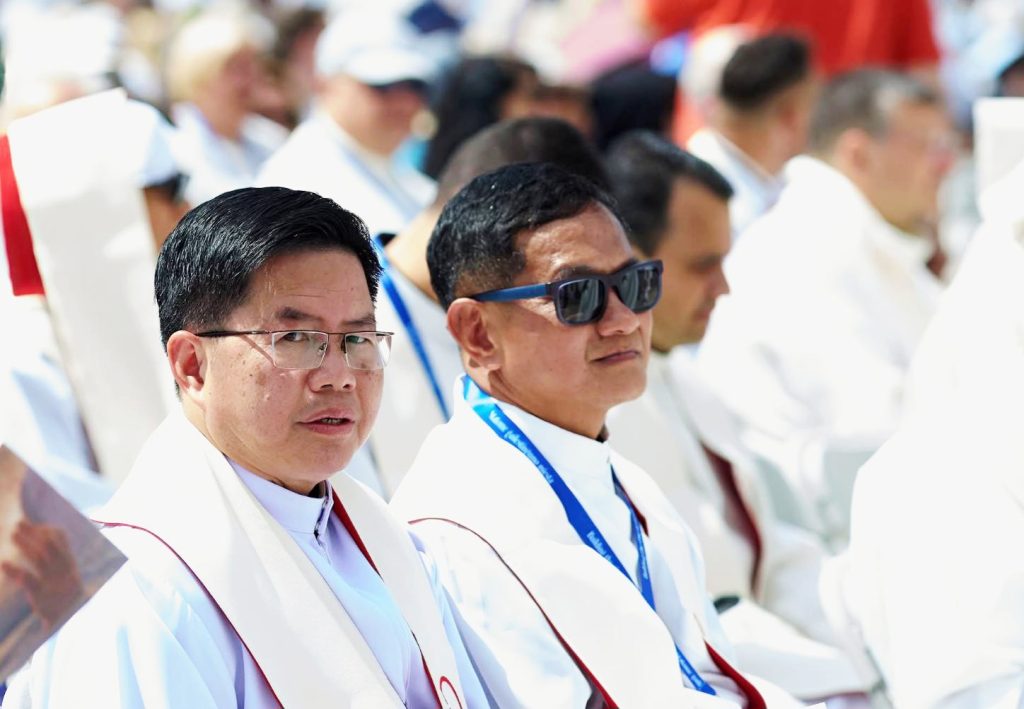
The group included Father Chalongrat Sangkharat, Father John Wirach Amonpattana, C.Ss.R., Ms. Panadda Nilkamhaeng, Mr. Nithat Navachatikosit, and two other lay faithful.
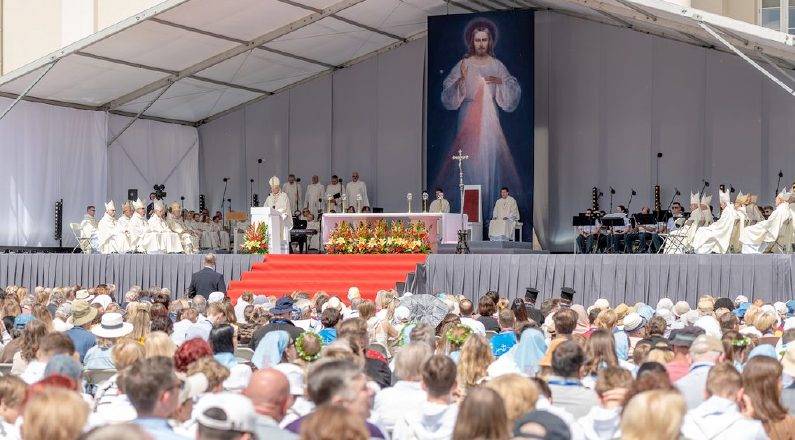
Over six days, the Thai delegates engaged in liturgical celebrations, theological exchanges, and pilgrimages following in the footsteps of Saint Faustina.
The congress structured its reflections around six theological pillars: the Church, Memory, the Word, Prayer, Practice, and the Human Heart.
Echoing the Magisterium: Church as Field Hospital
The Congress opened with Mass, a Eucharistic procession, and an official inauguration marked by unity among nations. Speakers anchored the discourse in the Church’s contemporary Magisterium, invoking Pope Francis’ enduring ecclesial metaphor.
The Church was challenged to look beyond rigid institutional boundaries and act fundamentally as a pastoral refuge.
“The Church is called to be a ‘field hospital’ whose primary duty is to heal the wounds of humanity, offering an unconditional sanctuary of welcoming, forgiveness, and grace for the marginalized.”
Participants were challenged to ask whether their communities truly welcome the poor, the wounded, and those distant from God. Mercy, speakers stressed, is not one activity of the Church but the heart of its identity.
Complementing this vision, Cardinal Grzegorz Ryś of Krakow addressed the dimension of “Memory,” asserting that recalling God’s historical interventions provides the spiritual foundation needed to navigate modern anxieties.
This theological framework was given human form through the testimony of John Pridmore, a former London crime boss whose life was transformed by Christ.
“I abandoned the guns I used to sin with, and now carry the rosary at all times,” he said.
Delegates also made pilgrimages to sites linked to Saint Faustina and the first Divine Mercy image in Vilnius.
From Sacred Scripture to Tangible Action
The Congress also examined the global geopolitical landscape. Delegations from war-torn regions, including Africa and the Middle East, shared testimonies of ministering to refugees and orphans amid displacement.
They described how they preach mercy amid war, poverty, and persecution. Scripture passages, especially the Prodigal Son and the Good Samaritan, were prayerfully explored to show that mercy is at the heart of God’s revelation.
Archbishop Rino Fisichella reminded delegates that authentic devotion requires concrete solidarity.
Representatives from Ukraine and other conflict zones shared their work with refugees, orphans, and the bereaved. Missions serving the poor, the sick, the elderly, and the abandoned illustrated Saint John Paul II’s teaching:
“Mercy is not a passive sentiment; it must become a tangible way of life. True charity manifests in physical and spiritual acts that alleviate the suffering of the abandoned.”
A New Horizon for Thailand
For the Thai delegation, the 2026 Congress on Mercy was more than a historical pilgrimage. It marked a renewal of faith and mission to spread Divine Mercy in Thailand.
The six-day journey—from Church to Memory, Word to Prayer, Prayer to Action, and Action to transformed hearts—echoed the message Christ gave Saint Faustina.
“All of us discovered that mercy is not merely a topic of spiritual reflection, but a way of life that the Church is called to live in the modern world,” Father Wirach Amonpattana said.
“The key message everyone took away was that building a ‘City of Mercy’ does not begin with any project or structure, but with hearts touched and transformed by God’s mercy, ready to endlessly share that mercy with others,” he added.
Carrying the spiritual momentum of the global assembly, the Divine Mercy Group of Thailand formally accepted the responsibility to host the 2027 Asian Apostolic Congress on Mercy (AACOM).
As the local Church prepares to welcome delegates from across Asia, the timeless prayer of Saint Faustina remains its pastoral compass: “Lord Jesus, I trust in You.”