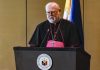

Caritas Thailand called on Christians to defend the dignity of vulnerable workers during a June 26 symposium in Bangkok marking the 135th anniversary of Rerum Novarum, as Church leaders reflected on labor justice amid the rise of the gig economy, monopolistic capitalism, and artificial intelligence.
Co-organized with the Catholic Bishops’ Conference of Thailand (CBCT), Saengtham College, and Catholic Social Communication Thailand (CSCT), the hybrid event drew hundreds of on-site and online participants, revisiting the document widely recognized as the foundation of modern Catholic Social Teaching.
Originally issued by Pope Leo XIII in 1891, Rerum Novarum addressed the social and economic upheavals of the Industrial Revolution, advocating fair wages, workers’ rights, and state protections for the poor while rejecting both unrestrained capitalism and state socialism.
From 19th-Century Factories to 21st-Century Algorithms
Father Paul Yodchai Lekprasert, a special lecturer at Saengtham College and former secretary of Caritas Thailand, told participants that while the tools of production have changed, the fundamental threat to human dignity remains the same.
“Capital cannot exist without labor, and labor cannot exist without capital,” Father Yodchai said, grounding his lecture in Pope Leo XIII’s teaching that economic systems must serve the human person.
He explained that the encyclical proposes a third path rooted in the ethical treatment of workers through fair wages, the right to unionize, and state protections for vulnerable people.
Father Yodchai also challenged modern institutions to examine their own practices.
“If steep inequality exists within our own organizations, true solidarity is impossible,” he said, adding, “Today’s exploitation hides behind the gig economy, underprotected migrant labor, and algorithmic automation that threatens job security.”
Living the Gospel Beyond the Church Walls
The symposium shifted from historical reflection to pastoral action during a panel discussion on how the Church should respond to contemporary labor issues.
Ms. Apinya Tajitt, deputy national director of Stella Maris Thailand and an internationally recognized advocate for trafficked fishers in Southeast Asia, urged participants to consider how the Church could move beyond institutional structures to become a “walking and applicable Gospel.”
She asked, “How can we make workers truly believe that the Church is walking alongside them?”
Father Winai Boonlue, vice rector of Saengtham College (Xavier Campus), echoed that appeal, describing the pursuit of social justice as an essential part of Thai Catholic identity.
He said social action is not an ideological or political agenda but a universal expression of God’s mission carried out without discrimination.
Voices from the Assembly
Participants attending in person and through the nationwide livestream also reflected on the continued relevance of Rerum Novarum.
For many lay Catholics, the symposium served as a reminder of the Church’s longstanding willingness to confront systemic economic injustice.
“I am deeply comforted to learn that the Church did not keep quiet during such historical upheavals,” one participant wrote online. “Instead, it chose to openly criticize unchecked capitalism for so often reducing laborers to mere instruments, completely ignoring their inherent human dignity, especially in the age of AI.”
Father Pairat Sriprasert, MI, CBCT assistant secretary for social affairs, opened the symposium by drawing on the Epistle of James, warning against the unjust accumulation of wealth and reminding participants that “God always hears the cries of the oppressed.”
As Thailand faces changing economic realities, speakers said the Church’s social teaching continues to offer an ethical framework for addressing inequality.
When crises or structural conflicts arise, Father Yodchai concluded, the Church’s first question must always be concrete: “Who is the poorest of the poor?” He said effective moral leadership must be guided by facts and an unwavering commitment to the most marginalized rather than by political rhetoric or economic interests.