

The Diocese of Chanthaburi in eastern Thailand concluded a pioneering workshop for lay Masters of Ceremonies (MCs) aimed at elevating the spiritual and celebratory quality of parish events.
Held July 6–7, the two-day training brought together parish MCs and representatives of various lay organizations across the diocese to develop a professional, deeply spiritual, and welcoming approach to serving the faithful.
Among the experts guiding the participants was Father John Baptist Nuphan Thasmalee, head of the Chanthaburi Diocesan Secretariat. In his presentation, Father Nuphan drew a parallel between the practical duties of a parish host and the theological insights of Pope Leo XIV’s 2026 encyclical, Magnifica Humanitas.
Released in May 2026, Magnifica Humanitas addresses safeguarding the human person in the rapidly evolving age of artificial intelligence. Father Nuphan challenged workshop participants to look beyond the technological dimension of the document and discover its deeper relational message.
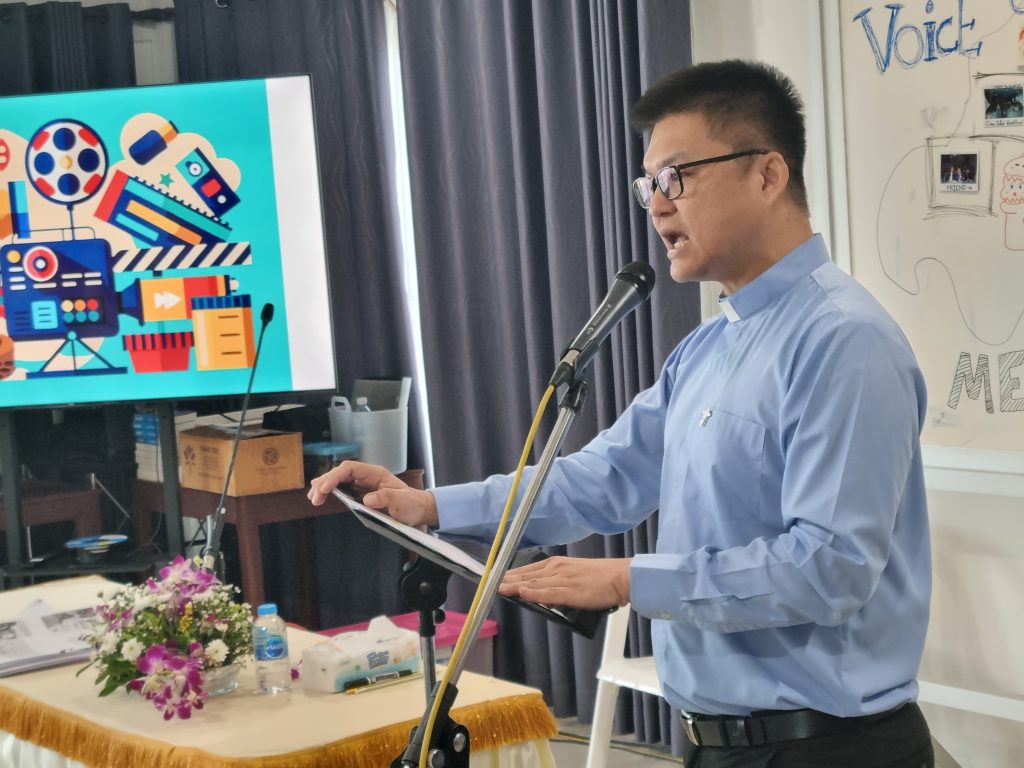
“While the document primarily addresses safeguarding human dignity in the age of artificial intelligence, its core message centers on the irreplaceable value of genuine human connection,” Father Nuphan explained.
Drawing on real-world scenarios, the diocesan secretariat chief translated papal teachings into practical guidance for liturgical and social hosting.
He stressed that an MC’s greatest asset is not an optimized schedule or a rigid script, but an authentic human presence.
“Your primary value is your humanity,” Father Nuphan advised. “Read the room and show genuine emotion.”
The workshop placed strong emphasis on the physical mechanics of public speaking and spatial presence. Father Nuphan said even an MC’s position within a sacred space carries symbolic and practical significance.
“Where you stand is absolutely critical,” he said. “It must be a vantage point where you can see everyone, and where everyone can see you.”
Reflecting on his own experience, Father Nuphan recalled speaking at a school assembly while seated in a central position.
“I don’t like standing right in the middle, and I don’t like sitting down, because it feels confining—like being tied up. That day felt unsuccessful because there was no eye contact, no real sense of participation from the students. When I stand in a place where I can observe the room, I can truly connect with the people,” he said.
To build lasting professional standards, the workshop introduced practical methods of self-evaluation, encouraging lay ministers to use modern tools for personal improvement.
Father Nuphan recommended that MCs record videos of their live performances to evaluate their body language, facial expressions, and vocal delivery.
The priest shared a lighthearted anecdote about staff members photographing him while speaking, often catching him with his mouth wide open or his arms outstretched. When he asked for more formal, reserved photographs, they playfully replied that none existed.
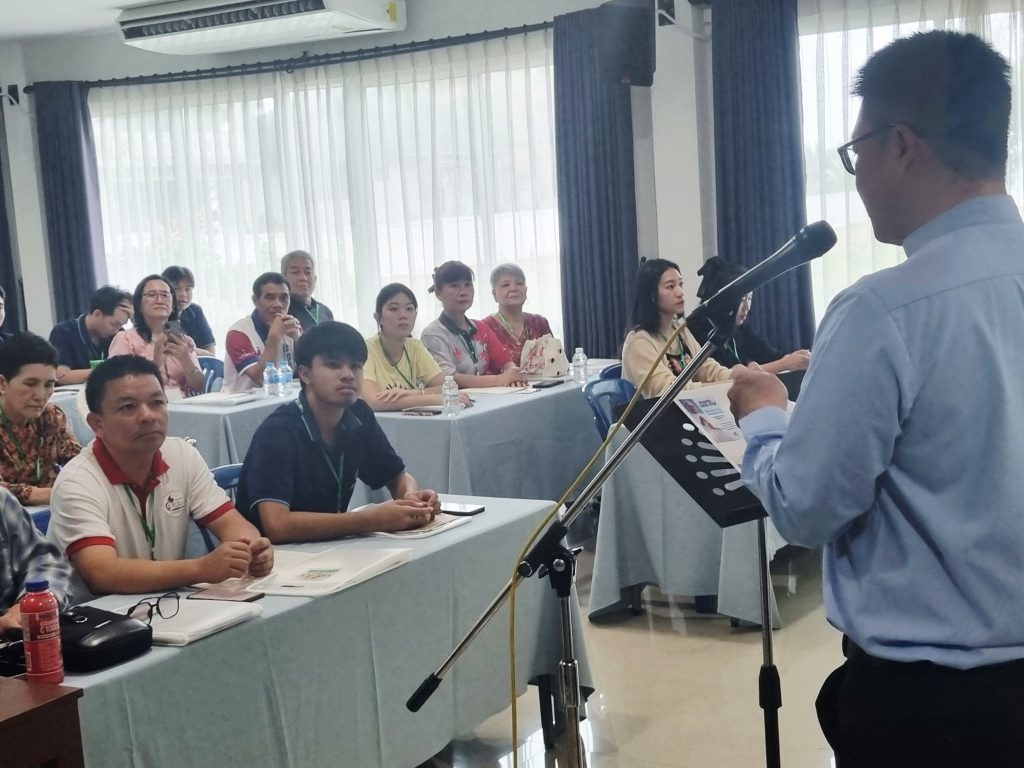
“We might think we are standing perfectly or behaving properly, but then when we speak, we may over-enunciate or make exaggerated gestures,” he observed.
“The tone of voice is equally vital. By recording ourselves and listening back, we can discern if we are speaking too quickly or if our diction is clear. Always ask: If I were the listener, how would I feel?” he added.
Concluding the workshop, Father Nuphan returned to the central message of Magnifica Humanitas: communication must always serve humanity by keeping the human person at the center of every encounter.
Just as the Holy See insists that emerging technology must serve human flourishing rather than diminish it, church communication must prioritize genuine human warmth over the mere transmission of information.
“An MC is no different,” Father Nuphan said. “We are not simply delivering raw information, nor are we standing at a podium reading a schedule aloud like a school inspector. That is merely data processing.
“Instead, we are called to welcome people. Greeting everyone celebrating at the church today with the hope that they are smiling. Speak directly to individual hearts and never forget to invite people into the conversation,” he added.









