

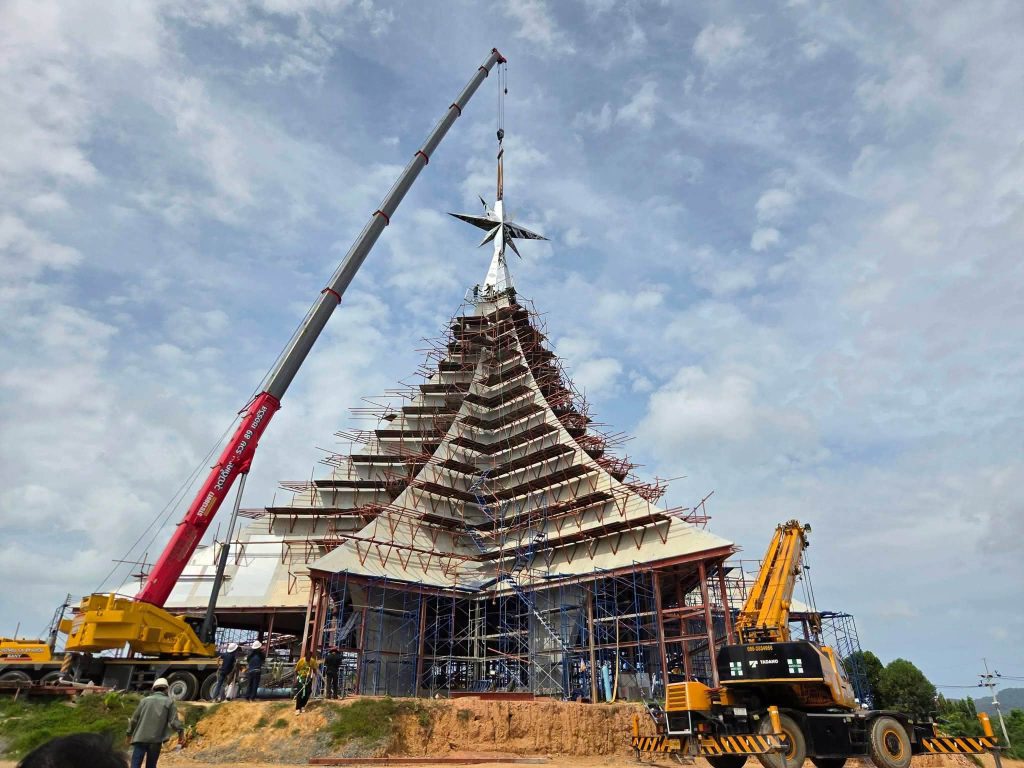
The Stigmatine Congregation in Thailand marked its 75th anniversary on Aug. 31 with the blessing and hoisting of the “Star Cross” atop a new church under construction in Phuket, an island province on the Andaman Sea.
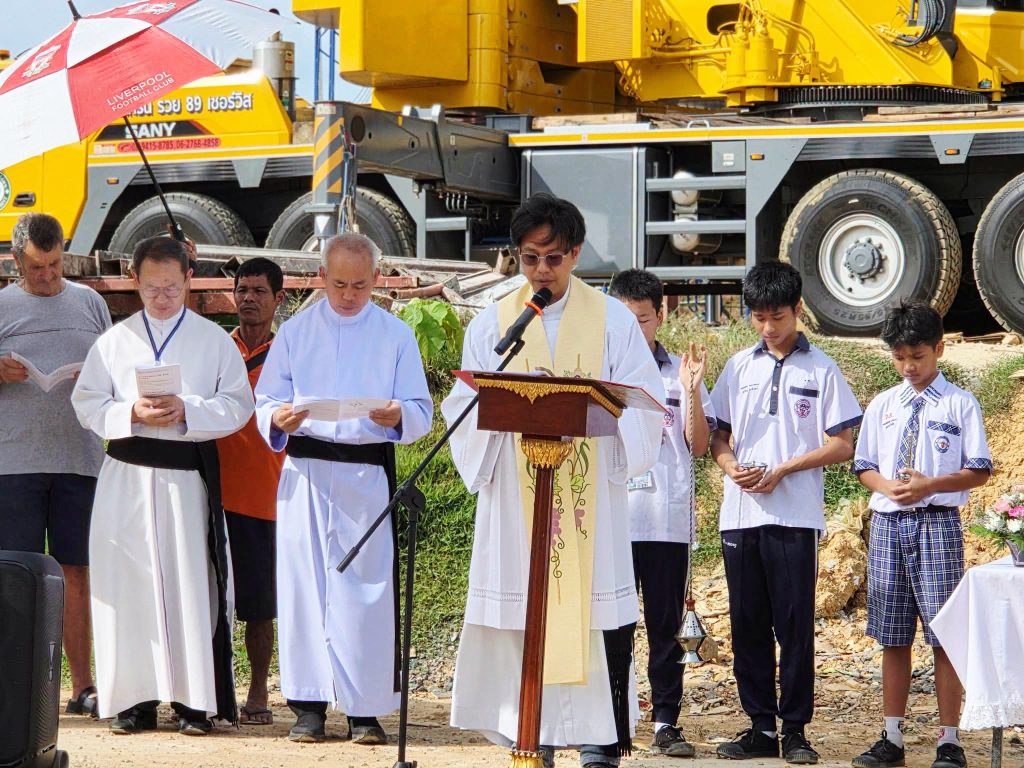
Fr. Reby Glenn Arazo, C.S.S., novice master for the Inter-Provincial Novitiate and a church administrator in Phuket, presided over the Liturgy of the Word at the construction site to invoke God’s blessings for strength and hope for the building project.
The ceremony marked both a construction milestone and a thanksgiving celebration for the 75th anniversary of the Stigmatine Congregation’s Mary the Morning Star Province in Thailand.
After the blessing, the Star Cross was hoisted to the top of the church as a visible sign of living faith and a reminder of the unending love of Jesus Christ.
Three Symbols, One Charism
Inside the Star Cross are three important symbols that embody the identity and spirituality of the Congregation of the Sacred Stigmata of Our Lord Jesus Christ (C.S.S.).
The first is the relics of St. Gaspar Bertoni, founder of the congregation, placed within to inspire members to live their vocations with humility, faithfulness, and compassion.
The second is the Holy Espousal Medal of the Blessed Virgin Mary and St. Joseph, patrons of the Stigmatine Congregation, invoked for their protection and maternal and paternal care over the church and the Stigmatine family.
The third is the five-pointed, star-shaped Holy Cross, symbolizing the five wounds — the sacred stigmata — of Jesus Christ and representing the spiritual and love-centered core of the Stigmatine charism.
In his reflection, Arazo reminded the faithful, “Raising the cross to the highest point of the church is a public declaration that salvation comes from Jesus Christ alone.”
He said the future church should become a focal point for all people, regardless of their joys, sorrows or pain, encouraging them to seek God’s mercy and the fulfillment of his love.
At the end of the ceremony, the congregation pledged that the new church would be more than just a building, but a sanctuary of God where all can gather to worship and praise him.
From Chanthaburi to the Andaman Coast: 75 Years of Grace
The celebration in Phuket marks a significant chapter in a 75-year journey.
The Stigmatine Congregation was founded on Nov. 4, 1816, in Verona, Italy, by St. Gaspar Bertoni (1777–1853) as a community of apostolic missionaries in service to bishops.
The Stigmatines arrived in Thailand in 1951, beginning their mission in the Apostolic Vicariate of Chanthaburi in the East.
The early missionaries learned the language and culture, serving small Catholic communities across Chanthaburi, Chonburi and Trat through parish ministry, education and catechesis.
As the Catholic Church in Thailand grew and the hierarchy was established in 1965, the Stigmatines continued their work. Over the decades, the mission expanded beyond the East, with Thai vocations flourishing and the congregation taking on formation, youth ministry and social apostolates.
Today, from its roots in the East, the Mary the Morning Star Province continues its mission primarily in southern Thailand under the Diocese of Surat Thani, serving communities along the Andaman coast, including Phang Nga, Phuket, Krabi and Ranong.
The Church has been engaged in pastoral and social outreach in these areas, especially after the 2004 tsunami.
The congregation is celebrating its jubilee year under the theme “From Wounds to Hope.”
The anniversary is a time to honor the Italian pioneers who left their homeland, the growing number of Thai confreres who carry the mission forward, and the benefactors, religious sisters and faithful families who have walked alongside the congregation.
For 75 years, the Stigmatines have lived their call to proclaim Christ crucified and serve the Church with special love for youth and the most abandoned.
The Star now atop the new church in Phuket reflects that mission, rooted in the wounds of Christ and the congregation’s hope for Thailand.









