
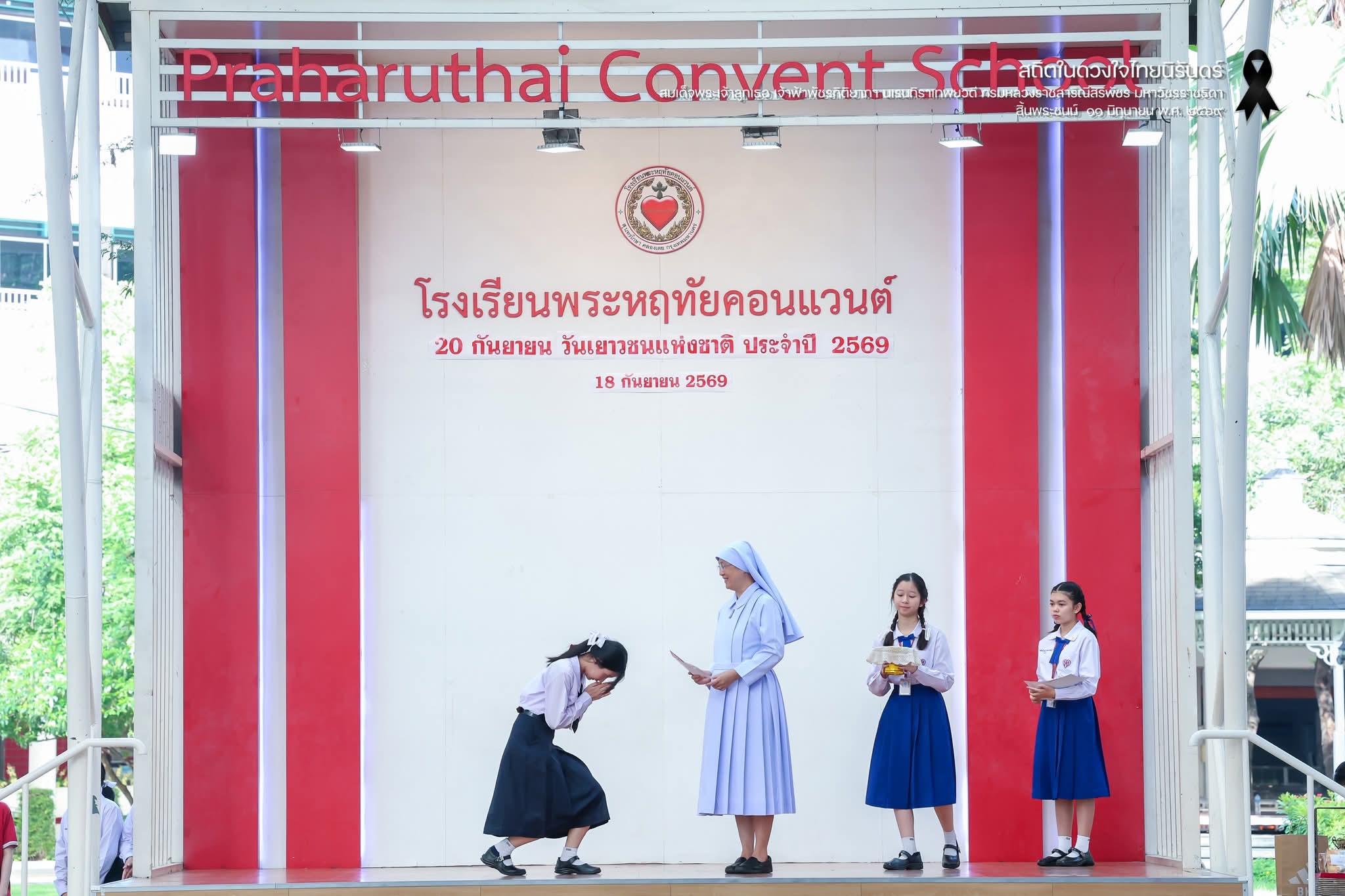
Catholic leaders in Thailand marked National Youth Day on Sept. 19 with calls for young people to become peacemakers, serve marginalized communities, and uphold human dignity amid the growing influence of artificial intelligence.
Catholic educational institutions, parishes and diocesan youth centers across the country joined the annual observance, which recognizes young people as a driving force in national development.
Thailand established National Youth Day in 1985 in line with the United Nations’ International Youth Year. The observance promotes youth development through education, life skills, and moral formation.
“Celebrated under the enduring national motto ‘Participation, Development, and Peace,’ this Civic Day closely reflects Catholic social teaching on human dignity, solidarity, and peacebuilding,” said Father Paul Eakarat Homprathum, secretary-general of the Catholic Education Council of Thailand, which encompasses about 400 schools, colleges and universities nationwide.
“Across the country, Catholic dioceses and schools are hosting youth gatherings, sports competitions, award presentations, community service initiatives, and Eucharistic celebrations aimed at bringing young people together in fellowship and leading them into a lived encounter with Christ,” he said.

In a pastoral message for the occasion, Archbishop Anthony Veeradet Chaiseri, vice president of the Catholic Bishops’ Conference of Thailand and chairman of its Catholic Commission for the Laity’s youth section, reminded young people that they are active agents of faith.
Drawing from the Gospel of John, Chaiseri cited Christ’s invitation: “You also are to bear witness, because you have been with me from the beginning.”
The archbishop said the passage calls young people to bear witness to a faith rooted in friendship with Christ and to become reconcilers in a divided world.
“Young people are called to be peacemakers in society—a role the world desperately needs. They are to act as bridgebuilders, bringing mercy and compassion to the poor, the marginalized, and the suffering.”
Father Dolthisak Chatbanyong, director of the bishops’ conference youth section, focused his message on the challenges facing young people in the digital age.
Addressing a generation raised on social media and increasingly sophisticated artificial intelligence, Dolthisak pointed to Pope Leo XIV’s first encyclical, Magnifica Humanitas.
The document presents two contrasting paths in humanity’s use of technological power: a “Tower of Babel” path driven by power and profit that reduces human value to data and algorithms, and a “City of Jerusalem” path centered on God, respect for diversity, dialogue, listening and shared responsibility.
“At times, we may feel awestruck—or even secretly afraid—of AI’s capabilities,” Dolthisak said. “It processes data brilliantly and operates with immense speed. Yet it lacks human conscience. Devoid of love, genuine feeling, and moral responsibility, AI can simulate intelligence, but it is not human.”

He said human limitations and vulnerabilities should not be regarded as flaws but as reasons for people to seek relationships, community, and unconditional love.
Dolthisak urged young people to ground their lives in four principles: nurturing a relationship with God, embracing human limitations as grounds for solidarity, sharing responsibility within local and global communities, and using language that promotes inclusion, dignity and unity.
“Wield the powerful tools in your hands to build a civilization of love through small, daily actions. Transform the digital world into a space where the wounded are heard—a space defined by justice and compassion,” Dolthisak said.