The Vatican’s ambassador to Indonesia has urged Catholic bishops to make the Church a force for peace and a welcoming home for marginalized communities amid growing conflict and social divisions.
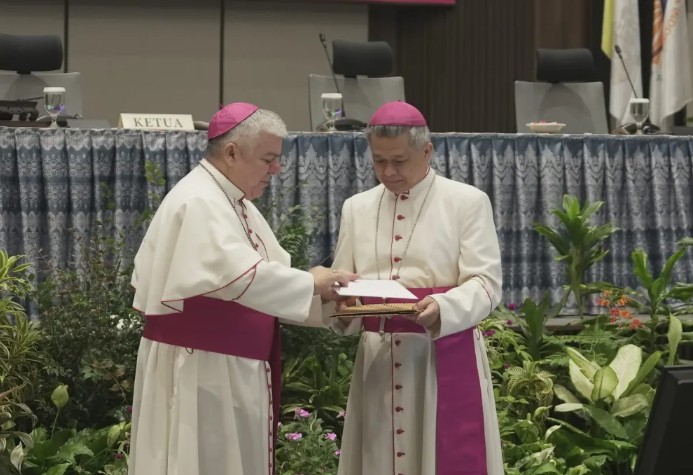
Archbishop Walter Erbì, apostolic nuncio to Indonesia, made the appeal during the assembly of the Indonesian Bishops’ Conference (KWI) in Jakarta on Nov. 4.
He called on the Church to promote peace through love, foster unity in diversity and strengthen communion among the faithful while responding to the challenges facing society.
According to KWI’s Social Communication Commission, the nuncio identified four themes guiding his mission in Indonesia: peace, unity in diversity, communion and mission.
Erbì said these principles must shape the Church’s daily life and ministry rather than remain abstract concepts.
He noted that conflicts and divisions have become increasingly evident in families, workplaces, communities and international relations.
Echoing Pope Leo XIV, the archbishop called for a peace that is “unarmed and disarming,” rooted in humility, perseverance and God’s unconditional love.
He said Christians must bring the peace of the risen Christ into a divided world, with the Church’s service to society firmly grounded in Christ’s teachings.
Erbì recalled Jesus’ commandments to love God and one’s neighbor, emphasizing that a close relationship with God enables people to overcome selfishness and recognize the dignity of others.
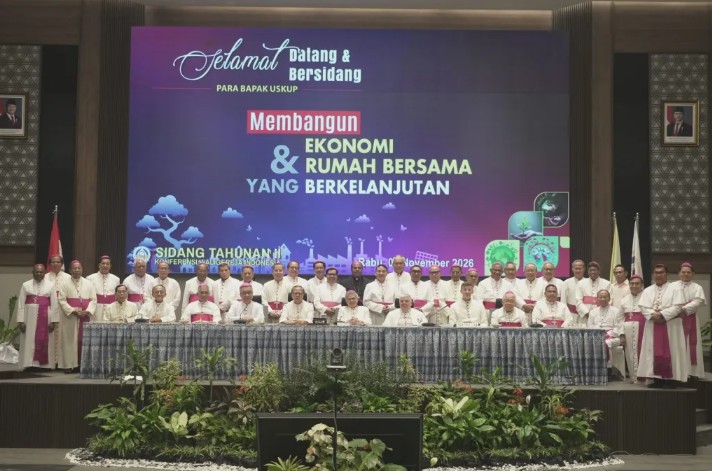
Photo supplied by KWI
Building communion within the Church
The nuncio also emphasized the importance of synodality, urging bishops, priests, religious communities and lay Catholics to work together in carrying out the Church’s mission.
He expressed his desire to accompany Indonesian bishops as a brother who listens, engages in dialogue and participates in spiritual discernment rather than remaining a distant authority.
Acknowledging the responsibilities and occasional loneliness of episcopal ministry, Erbì encouraged open conversations and mutual trust among Church leaders.
He referred to Pope Francis’ image of the polyhedron in the apostolic exhortation Evangelii Gaudium to explain how different members of the Church contribute to a common mission while retaining their distinct gifts and responsibilities.
“The whole is greater than the part,” he emphasized.
Erbì said challenges facing the Church require cooperation and openness rather than isolated efforts.
He also stressed that synodality requires attention to those who struggle to keep pace with others.
Those moving faster must be willing to wait, while those facing difficulties should receive encouragement and support, he said.
The goal, he explained, is for the entire People of God to journey together rather than for individuals or groups to reach their destination ahead of others.
Responding to human suffering and technological change
Erbì said the Church’s mission extends beyond religious programs and activities to making Christ’s love present in people’s lives, particularly through service to those experiencing suffering, uncertainty and exclusion.
Recalling Pope Paul VI’s description of the Church as an “expert in humanity,” he emphasized its responsibility to understand human struggles and help people discover their path toward God.
The nuncio also recognized the growth of the Catholic Church in Indonesia, noting its development from a Church that primarily received foreign missionaries into one that now sends Indonesian missionaries to other countries.
He reminded bishops that missionary work does not necessarily require traveling abroad.
The Church also fulfills its mission by welcoming people, responding to changing circumstances and accompanying communities through everyday challenges.
Erbì addressed the rapid development of artificial intelligence, warning that its implications extend beyond technological concerns.
He said AI increasingly influences human relationships, decision-making, social structures and perceptions of human dignity.
Although technical solutions and public policies are necessary, he emphasized that they are insufficient without a broader commitment to human dignity.
The Church, he said, must promote a renewed Christian humanism rooted in Christ as it responds to technological change.
Drawing on the biblical account of Nehemiah rebuilding Jerusalem, Erbì highlighted the importance of collective responsibility in addressing challenges that cannot be resolved through individual efforts alone.
A welcoming home for the vulnerable
The archbishop urged the Indonesian Church to become a place of encounter, healing and belonging, particularly for people experiencing poverty, oppression and social exclusion.
He called on Church communities to give greater attention to the poor, the elderly, the forgotten and those who lack the power to make their voices heard.
Families, young people and individuals struggling with uncertainty, addiction or a loss of direction also require pastoral accompaniment, he said.
Erbì emphasized that the Church must be more than an institution. It must offer a welcoming home to people who feel alienated, rejected or unwanted.
He urged Catholics to translate their commitment to peace and unity into concrete acts of service, compassion and respect for human dignity.
The nuncio also expressed gratitude for the welcome he had received since arriving in Indonesia in early September.
He thanked Cardinal Ignatius Suharyo, KWI Chairman Archbishop Antonius Subianto Bunjamin, OSC, fellow bishops, priests, religious men and women, and lay Catholics for their support.
Erbì also acknowledged his predecessor, Archbishop Piero Pioppo, who served as apostolic nuncio to Indonesia for eight years before taking up a new diplomatic assignment in Spain.
Expressing gratitude to Pope Leo XIV for entrusting him with the mission, Erbì acknowledged the responsibilities of his appointment and his dependence on God’s guidance and the support of the faithful.
He expressed hope that the Church in Indonesia would continue growing as a peacemaker and witness to Christ’s love, guided by the Holy Spirit and the protection of the Blessed Virgin Mary.
The archbishop also said he wanted to deepen his understanding of Indonesia’s cultural heritage and the experiences of its Catholic communities.
He invited bishops, priests, religious communities and lay Catholics to become his teachers as he begins his diplomatic and pastoral mission.
“I myself will first learn to listen,” he said.