

The power of Catholic principles to shape compassionate and ethical health professionals took center stage at the opening of the International Conference on “Power of Education and Health Care in the Ever-Changing World,” hosted by Saint Louis College in Bangkok on September 4.
Speaking at the 40th anniversary celebration of St. Louis College (SLC), keynote speaker Dr. Chainarong Monthienvichienchai, chancellor of St. John’s University and vice chairman of the Catholic Education Council of Thailand, called for a renewed commitment to Catholic values in health professional education as a living legacy, urging educators and nursing students to embrace compassion, ethics, and service as essential to the future of healthcare.
“Catholic healthcare education is more than professional training. It is rooted in the belief that every human being is created in the image of God,” Chainarong said. “This conviction shapes how we teach, how we serve, and how we care.”
The two-day conference brought together hundreds of educators, health professionals, SLC alumni, and faith leaders from across Thailand and abroad to explore the intersection of academic excellence, ethical care, and human dignity.
The commemoration highlighted the vision of His Eminence Michael Cardinal Michai Kitbunchu, who founded the nursing college in Bangkok four decades ago. It is managed by the Sisters of St. Paul de Chartres in Thailand.
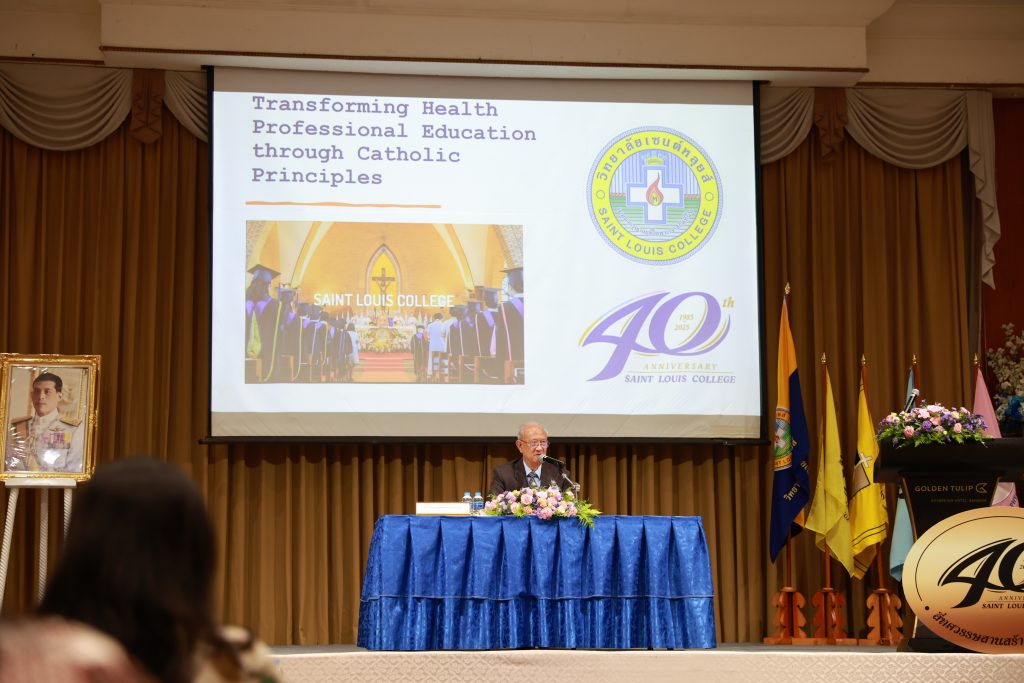
What began as a seed of hope, Chainarong noted, has become “a living legacy—forming health professionals who serve with both skill and compassion.”
“This college was born out of the conviction that education rooted in Catholic values can form not only excellent nurses but also men and women of compassion, integrity, and service,” Chainarong said.
He emphasized that Catholic principles of human dignity, compassion, ethics, and service are not only timeless but urgently needed in today’s world of rapid medical and social change. “These values ensure that our graduates are not only competent but also witnesses of hope, especially to the poor, the sick, and the forgotten,” he said.
Quoting Pope Francis’ 2017 address to healthcare workers, Dr. Chainarong reminded participants that “the Church’s mission in health care is to continue Jesus’ mission of healing and mercy, with special concern for the poorest and most abandoned.”
Caring for others is not an occasional task; it is the very heartbeat of Christian living. Each act of love is a reflection of Christ’s love in us.
The keynote emphasized three main challenges facing health education today: rapid advances in technology, increasing ethical dilemmas in medical practice, and the urgent need to integrate compassion with professional competence.
Dr. Chainarong urged Catholic institutions to prepare graduates not only with skills and knowledge but also with the moral compass to act as “change agents” for a more humane society.
Illustrating his message with real-life stories of nurses and educators, he called on health professionals to embody the principle: “Speak to the patients and people you meet in your daily life in a way that if they died the next day, you’d be satisfied with the last thing you said to them.”
Looking ahead, Dr. Chainarong presented a vision of transformation in health professional education that blends innovation with faith. He urged collaboration across Catholic institutions and called for renewed investment in holistic formation.
“Our task,” he concluded, “is to ensure that the next generation of health professionals are not only highly skilled, but also men and women who heal with compassion, guided by conscience, and strengthened by faith.”
The conference continues with plenary sessions, workshops, and international exchanges, with participants expected to draft proposals for advancing Catholic health education in Thailand and beyond.









