

Thai religious leaders, including senior Buddhist monks and Catholic representatives, joined faith leaders from around the world at the International Meeting for Peace in Rome.
The Sant’Egidio Community organized the dialogue among religions and cultures from October 26 to 28.
The gathering brought together prominent figures from major world religions, civil society, academia, and politics under the shared conviction that “peace is worth the risk.”
Participants addressed some of the most urgent challenges of the modern world — promoting peaceful coexistence, solidarity, and a renewed vision of global harmony.
60th anniversary of Nostra Aetate
Coinciding with the Sant’Egidio meeting, the Vatican’s Dicastery for Interreligious Dialogue and the Commission for Religious Relations with the Jews hosted a special event on October 28 titled “Walking Together in Hope” at the Paul VI Hall in the Vatican.
The event marked the 60th anniversary of Nostra Aetate, the groundbreaking Second Vatican Council declaration on the relation of the Church to non-Christian religions, whose Latin title means “In Our Time.”
The commemoration, presided over by Pope Leo XIV, celebrated six decades of progress in interreligious understanding and reaffirmed the Church’s commitment to dialogue, respect, and peace.
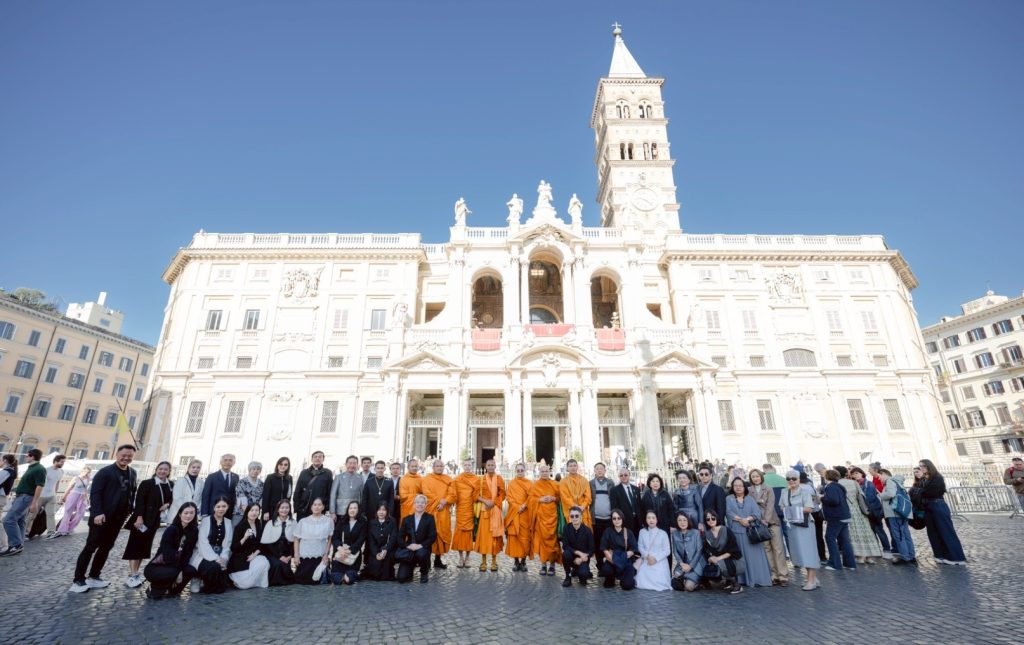
Among the attendees were religious leaders from various faith traditions — including Thailand — as well as scholars, diplomats, and Vatican officials.
The declaration, described by both Pope John Paul II and Pope Benedict XVI as the Magna Carta of the Church’s new approach to other religions, marked a historic shift in the Church’s relationship with non-Christian faiths.
Pope Francis and now Pope Leo XIV have continued to build upon this foundation, emphasizing bridge-building and collaboration across religious boundaries.
A Thai perspective
Speaking from Rome, Fr. Joseph Anucha Chaiyadej, Secretary General of the Office of Social Communication of the Catholic Bishops’ Conference of Thailand (CSCT), told LiCAS News that the Vatican ceremony opened with a solemn procession of religious leaders — a vivid symbol of unity and the ongoing journey of interfaith dialogue.
Reflecting on the declaration’s legacy, Fr. Anucha noted that in the six decades since its publication, relations between Catholics and followers of other faiths — particularly in Thailand — have undergone a “radical transformation.”
“This shift, from centuries of misunderstanding to mutual respect, can rightly be called nothing less than a miracle,” he said.
He also shared his deep impression of Pope Leo XIV’s address during the celebration:
“Sixty years ago, with the promulgation of Nostra Aetate, the seed of hope for interreligious dialogue was planted,” the Pope said. “Today, your presence is a witness that this seed has grown into a powerful tree, whose branches spread far and wide, providing shelter and bearing abundant fruit of understanding, friendship, cooperation, and peace.”
Among the Thai delegation were Somdej Phra Maha Thirachan, Abbot of Wat Phra Chetuphon Royal Temple (Wat Pho); Phra Pramote from the King Prajadhipok’s Institute; and Archbishop Francis Xavier Vira Arpondratana, CBCT President and Archbishop of Bangkok.
‘Enough of war’
The gathering culminated with a solemn Ceremony for Peace at Rome’s Colosseum, attended by Pope Leo XIV and numerous world religious leaders. The Pope referenced Nostra Aetate in his interfaith prayer for peace, reminding those present that all people share a common dignity as children of God.
“We cannot truly pray to God as Father of all if we treat any people as other than sisters and brothers, for all are created in God’s image,” Pope Leo declared.
In his closing appeal, the Pope urged the faithful to reject violence and commit to reconciliation:
“Conflicts are present in all parts of life, but war is no help in finding solutions. Peace is a constant journey of reconciliation. Enough of war — with all the pain it causes through death, destruction, and exile!”
As voices from across the globe joined in prayer, the message that resonated throughout the Eternal City was clear — that dialogue, friendship, and shared faith can indeed be the pathways to lasting peace “in our time.”









