South Korea’s Catholic medical network has launched the country’s first hospital AI ethics charter, with Church leaders insisting that artificial intelligence must never replace human compassion and responsibility in caring for the sick.
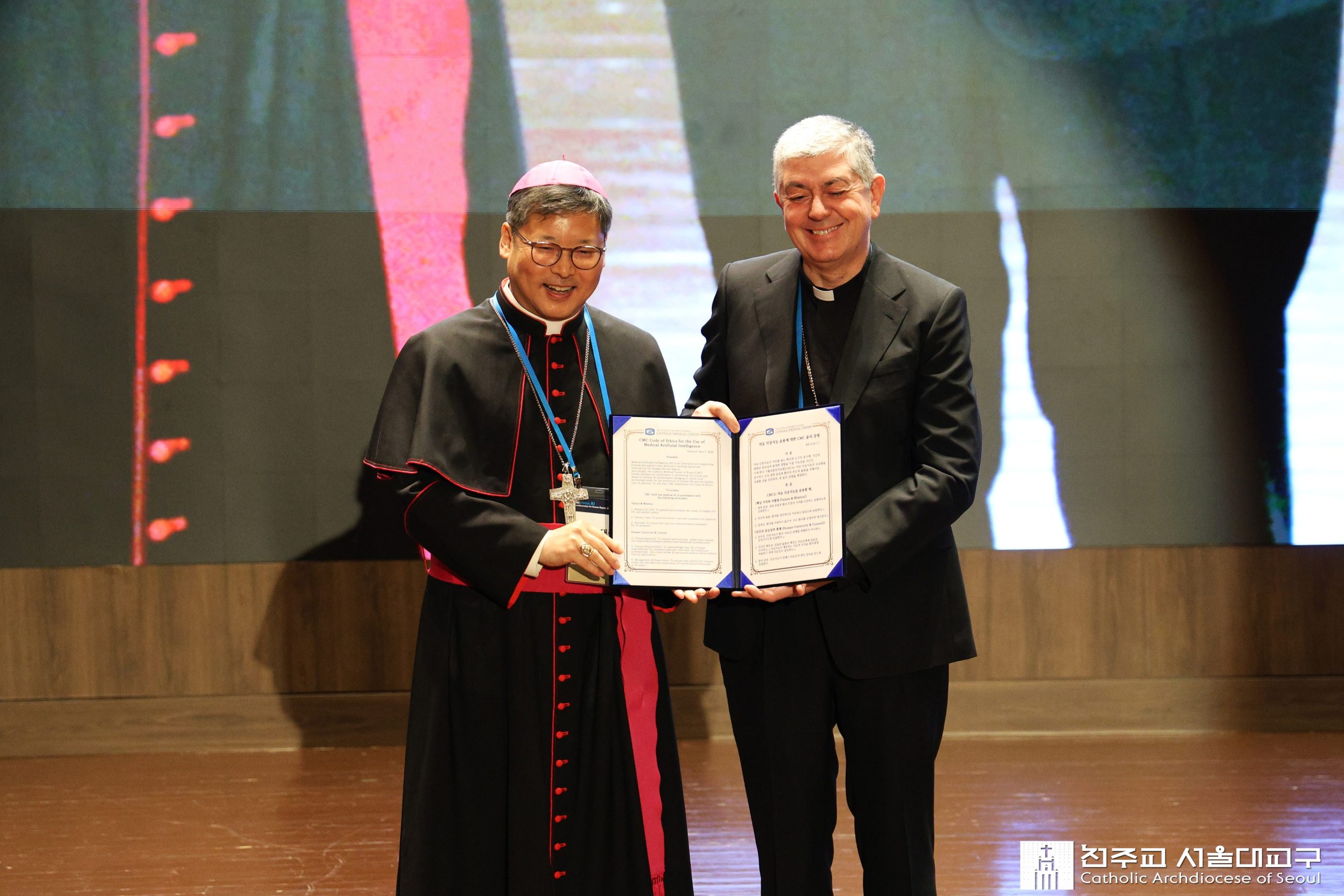
The Catholic Medical Center (CMC), one of the country’s largest Catholic healthcare systems, formally unveiled its “Medical AI Ethics Charter” during the “CMC Ethical AI Transformation Symposium” held May 7 at the Catholic University of Korea in Seoul.
The charter outlines four core principles and 12 implementation guidelines centered on human dignity, medical accountability, data ethics, social justice, and ecological responsibility.
Its provisions include commitments to ensure that artificial intelligence strengthens rather than replaces relationships between patients and healthcare workers, that medical personnel remain ultimately responsible for treatment decisions, and that patient privacy and fairness are protected.
Archbishop Peter Chung Soon-taick attended the symposium alongside Archbishop Giovanni Gaspari, government officials, healthcare executives, and academic leaders.
In his address, Archbishop Chung said healthcare must remain rooted in human relationships despite rapid technological advances.
“The essence of healthcare is not the transmission of knowledge, but a ‘human relationship’ in which life recognizes and respects another life,” he said.
He warned that while machines may assist healthcare workers, they cannot replace human accompaniment and compassion.
“Machines can analyze suffering, but they cannot accompany us in the face of that suffering,” he said, stressing that such accompaniment “must remain a human responsibility.”
The archbishop also expressed hope that even in an AI-driven medical environment, patients would continue to encounter compassion through healthcare workers.
“Even on the day when artificial intelligence becomes fully integrated into medical practice, I pray that those who suffer may still feel, through healthcare workers and by their side, that they are loved by God,” he said.
Archbishop Gaspari echoed similar concerns, cautioning against allowing technological progress to erode human values.
“We sometimes want to rely on this ‘intelligence,’ which appears almost omnipotent, to solve our problems,” he said. “But the truly important task is not to humanize artificial intelligence, but to preserve and cultivate the essence of our humanity in an increasingly technological world.”
The Vatican envoy thanked the Catholic Medical Center and the university’s Institute for Information Convergence Promotion for what he described as a meaningful and pioneering effort to establish ethical standards for medical AI.
The charter includes commitments to uphold respect for life, holistic care, fairness, transparency, explainability of AI-generated medical advice, environmental protection, and the use of AI-related knowledge and data for the common good.
Min Chang-ki, vice president for medical affairs at the Catholic University of Korea and president of the Catholic Medical Center, described the declaration as a commitment to ensure that innovation does not come at the expense of patient dignity.
“The official proclamation of the Medical AI Ethics Charter is a declaration that protecting the patient’s experience of being treated with dignity is as much an innovation as improving the clinical usefulness of AI,” he said.
He added that he hoped the initiative would become “the starting point for establishing practical ethical standards for medical AI in South Korea.”