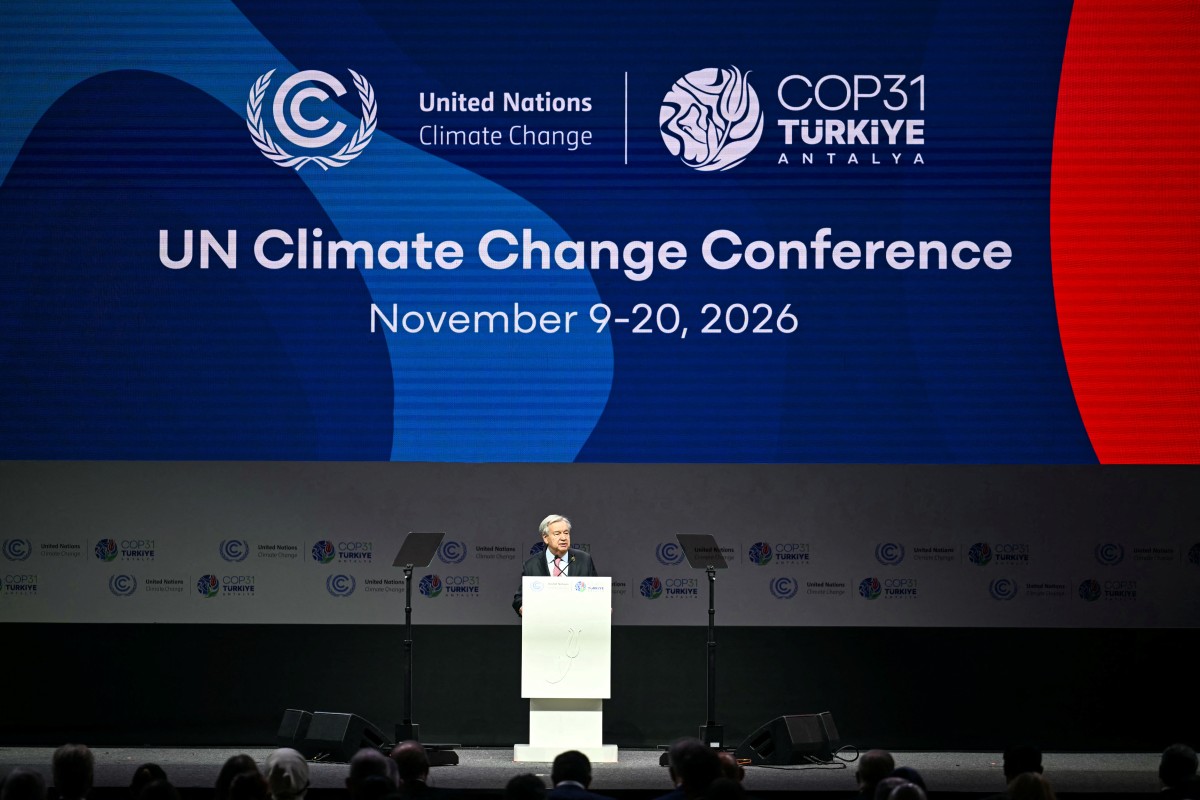
United Nations Secretary-General António Guterres called on governments to tax fossil fuel companies’ windfall profits to help developing countries recover from climate disasters and finance their transition to cleaner energy.
Addressing world leaders at the COP31 climate summit in Antalya, Türkiye, on Nov. 11, Guterres proposed a global climate justice agreement to support countries suffering the worst effects of global warming despite contributing relatively little to the crisis.
“Polluters must pay,” Guterres said, drawing applause from delegates.
He cited the disparity between the earnings of major oil companies and the funding available to countries facing climate-related losses and damage.
The world’s nine largest oil companies earned $95 billion in a single quarter, compared with approximately $600 million received by the international fund established to help vulnerable countries recover from climate disasters, Guterres said.
The fund’s total represented just 14 hours of those companies’ profits, according to the UN chief.
Guterres accused fossil fuel interests of distorting climate science and delaying efforts to reduce greenhouse gas emissions.
“Fossil fuels must go the way of the dinosaurs,” he said. “The dinosaurs did not have a lobby. Fossil fuels do.”
The proposed climate justice compact would help developing countries move away from fossil fuels while protecting communities already affected by rising temperatures and extreme weather.
“We cannot demand that countries transform their economies while denying them the means to do so,” Guterres said.
The proposal outlines four priorities: accelerating the transition to renewable energy, protecting vulnerable populations, providing affordable climate finance and strengthening international cooperation.
It also calls for national transition plans that protect workers and communities, expanded early-warning systems and faster assistance following climate disasters.
Guterres urged wealthy countries to fulfill their climate finance commitments and increase investment in developing nations.
His appeal came as COP31 negotiators remained divided over adaptation financing, assistance for climate-related losses and damage, and measures to support a just transition to cleaner economies.
Developing countries pressed for more predictable funding, warning of shortfalls in financial support for climate adaptation and other measures.
Nepal’s request for assistance following a glacial collapse also raised questions about how quickly emergency financing could reach communities affected by climate disasters.
Guterres warned that existing national climate commitments would still put the planet on a path toward more than 2.5 degrees Celsius of warming by the end of the century, even if fully implemented.
“Our planet is heating up. The clock is winding down. It’s make or bake time,” he said.
He urged governments to strengthen efforts to cut emissions despite the prospect of exceeding the 1.5-degree Celsius warming threshold.
“Science is not telling us to surrender. It is telling us to fight harder,” Guterres said.
Turkish President Recep Tayyip Erdoğan, whose country is co-hosting COP31 with Australia, acknowledged that three decades of international climate negotiations had failed to produce sufficient results.
“This success at the level of ideas has not produced the same results when it comes to implementation,” Erdoğan said, calling for greater support for developing countries.
Brazilian President Luiz Inácio Lula da Silva warned that wars and trade disputes were diverting international attention from climate change.
“We started talking more about weapons and tariffs than the survival of future generations,” Lula said.
He announced that Brazil would develop national road maps to reduce its dependence on fossil fuels and end deforestation, building on discussions at COP30 in the Brazilian Amazon last year.