
After a century of mission work in India, the Salesians of Don Bosco operate 11 provinces and hundreds of education and youth-care institutions serving some of the country’s poorest communities.
The Salesians of Don Bosco have worked in India for 100 years, focusing on education, vocational training, and support for children, adolescents, and young people living in vulnerable conditions, particularly in eastern India, Fides News Agency reported.
The Salesians first arrived on the Indian subcontinent in Shillong, northeastern India, during the British colonial period.
At the time, the region was considered an unstable border area, inhabited largely by tribal communities and valued mainly for its strategic importance to the British Empire.
Their early mission unfolded in the aftermath of World War I, when colonial authorities feared unrest in remote territories.
From their initial base in Shillong, the Salesians later moved their provincial headquarters to Calcutta and expanded their presence across the country.
Today, the congregation operates 11 provinces in India, along with 420 Don Bosco Tech centers, 174 shelters for at-risk youth, and 34 migrant support centers.
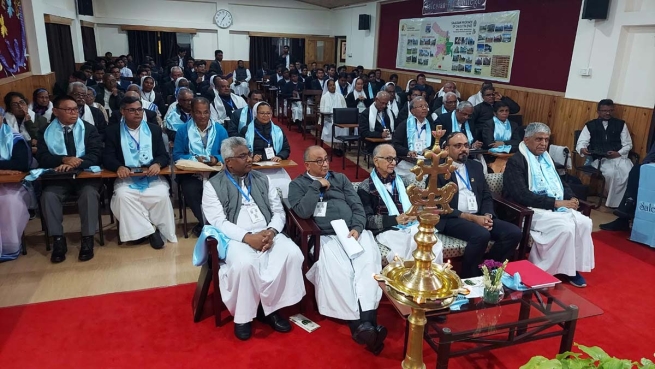
The Salesian Province of Calcutta is marking its centenary with the visit of the Rector Major, Father Fabio Attard, who is expected to arrive in Calcutta on Feb. 5.
During his visit, he will meet members of the broader Salesian family, including religious brothers, Salesian nuns, alumni, lay cooperators, and missionaries.
Fides reported that the Salesians initially focused on vocational training for unemployed young people, who were often labeled as potential “troublemakers.”
Through training in crafts such as printing, carpentry, tailoring, and mechanics, the Salesians equipped young people with practical skills and pathways to employment.
From 1926 to 2026, the Salesians of Calcutta marked a century of service that included training educators, welcoming street children and restoring their dignity, founding schools, and forming leaders in surrounding regions. The Calcutta Province today covers Bihar, Sikkim, Bangladesh, and Nepal.
The province includes 40 houses staffed by 242 Salesians, who serve 32 parishes and oversee more than 25 educational institutions. Its education network includes 30 secondary schools and 13 vocational schools.
The Salesians officially arrived in Calcutta on Nov. 11, 1925, when three members were entrusted with the Catholic Orphan Press and the adjacent cathedral parish. They soon began traveling to surrounding areas, learning the Bengali language and engaging with local culture.
A Don Bosco institution was established in Krishnagar as early as 1928. The Salesians were also entrusted with Saints Peter and Paul Primary School, which was upgraded to a secondary school in 1951.
Particular emphasis was placed on mission work among indigenous Santhal communities, initially in parts of West Bengal and later extending into Bihar and Nepal.
The Salesians also expanded their mission into Nepali-speaking regions of North Bengal, Sikkim, and Nepal. Their relationship with Nepal dates back to the founding of the Salesian College in Sonada in 1938. In 1963, the parish of Sonada in the Diocese of Darjeeling was placed under their pastoral care.
Their work further extended to areas now forming Bangladesh, then part of India. From 1928 to 1952, the Salesians served communities that later became part of the Diocese of Khulna.
After the partition of India in 1947, these areas were incorporated into East Pakistan and later became Bangladesh following independence in 1971.
Across these regions, Fides said, the Salesians of Don Bosco continue to be valued for their care of children and their educational work with adolescents and young adults, contributing to long-term social development through sustained engagement in education and youth formation.









