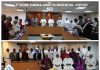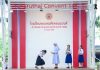

Bishop Celso Ba Shwe of Myanmar’s Diocese of Loikaw visited Chiang Mai’s new bishop, Peter Suphot Roeksujarit, reinforcing a cross-border pastoral mission to displaced communities on Aug. 3.
Accompanied by Father Marko Phe Bya, the delegation met at the Chiang Mai Catholic Mission to offer congratulations and affirm the enduring ties between the two dioceses.
Recalling Border Ministry
The encounter served as both a celebratory milestone for the Diocese of Chiang Mai and a moment of recollection.
Father Marko Phe Bya recalled his years of pastoral service among refugees and displaced migrants along the border in Thailand’s Mae Hong Son province before returning to his duties in Loikaw. His experience highlighted the personal and institutional ties connecting the two dioceses across national boundaries.
For decades, pastoral care for displaced communities in northern Thailand has involved cross-border cooperation.
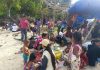
Amid continuing conflict in Myanmar, thousands of people, predominantly from the Karen and Karenni ethnic communities, have sought shelter along the border. In response, the Catholic Bishops’ Conference of Thailand and the Diocese of Loikaw have maintained spiritual and humanitarian support for displaced families.
“To accompany those in the camp shadows is to ensure that no distance, displacement, or hardship can extinguish the dignifying presence of Christ among His people.”
Pastoral Presence Amid Challenging Terrain
To bridge cultural and linguistic divides, the Church in Myanmar regularly assigns native priests and religious sisters to serve as camp chaplains.
In places such as Ban Mai Nai Soi, or Camp 1, and Ban Mae Surin, or Camp 2, where a significant number of residents are Catholic, chaplains help sustain parish life.
The ministry operates under difficult physical and logistical conditions. Because of administrative and military security protocols, many chaplains are restricted from residing inside the camps.
Instead, they make daily trips from nearby Mae Hong Son town, traveling through mountainous terrain and monsoon-slicked roads to administer Holy Communion and the sacrament of reconciliation. Others remain confined within camp perimeters, sharing the daily isolation experienced by displaced communities.
Through retreats, youth groups and parish choirs, clergy provide spiritual support and help strengthen community life among uprooted families.
Institutional Aid and Emergency Response
The Church’s humanitarian organizations complement its pastoral ministry by providing assistance to vulnerable communities.
Catholic Office for Emergency Relief and Refugees: Established by the Catholic Bishops’ Conference of Thailand, COERR operates across all nine border camps. Community social workers provide agricultural training and specialized assistance to extremely vulnerable individuals.
Jesuit Refugee Service Asia Pacific: Through its Pastoral Accompaniment initiative, JRS facilitates Family Friendship Groups aimed at rebuilding community trust, provides psychosocial trauma counseling and supports small-scale animal husbandry projects to strengthen self-reliance.
When renewed violence in Myanmar forces people across the border, the pastoral network also responds to emergency needs.
Local Church groups, including St. Genoveva Parish working with Caritas Thailand, deploy off-road vehicles carrying survival kits, clean water, rice and essential medicines to temporary shelters.
The teams coordinate with Thai-Myanmar border administrators and local health authorities to monitor health threats, including malaria, particularly during the monsoon season.
Protecting the Next Generation
Because minors constitute more than half of the refugee population along the border, the joint mission places particular emphasis on child protection and human development.
Church networks operate residential boarding homes near and within camp boundaries, providing safe spaces for orphans and children living in vulnerable circumstances.
Young people receive instruction in Thai, English and digital literacy. By combining protection with education and skills training, Church organizations seek to safeguard vulnerable children from exploitation while preparing them for social integration or an eventual return to their homeland.
As Bishop Celso Ba Shwe and Bishop Peter Suphot Roeksujarit concluded their meeting, the visit reaffirmed the commitment of both dioceses to accompany displaced communities along the border as the Diocese of Chiang Mai begins a new chapter under its new bishop.